Wednesday, November 01, 2006

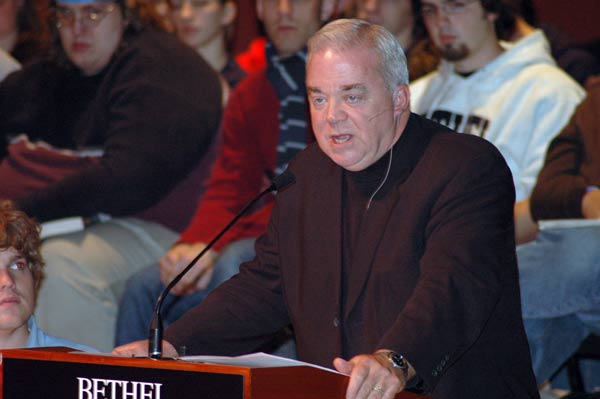
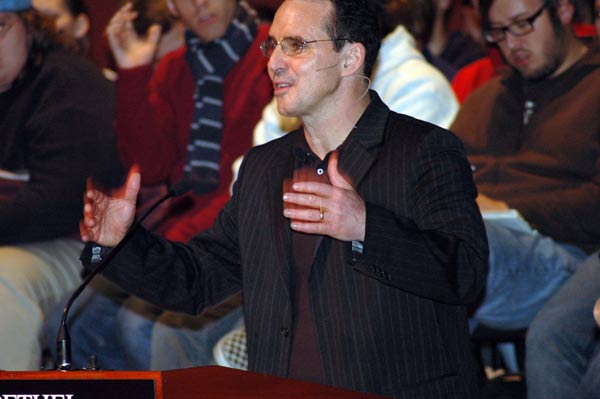
Greg Boyd and Jim Wallis at Bethel University


Wallis-Boyd Event Draws Large Crowd: Audio Now Available

The Benson Great Hall was filled beyond capacity on Monday October 23rd as the Bethel Student Association hosted "Faith and Politics: Should They Mix?" with Rev. Jim Wallis (author of God's Politics and president and founder of Sojourners/Call to Renewal) and Greg Boyd (author of The Myth of a Christian Nation and senior pastor at Woodland Hills Church). Click here for audio of the Wallis-Boyd event as an MP3 file or click here for streaming audio using RealPlayer.

Earlier this year Donald Miller (author of Blue Like Jazz) also spoke at the college as a part of the college's chapel service . Click here for audio of Donald Miller's presentation as an MP3 file or click here for streaming audio using RealPlayer.

Related Tags: , , , , , , , , , , , , , , , , , , , , , , , , , , , , , ,

Presentation Service for Justin Irving - Rooted and Relevant

Yesterday I had the opportunity and honor to serve as an usher for Justin Irving's presentation service at Bethel Seminary. Justin was interviewed, and approved for being a full professor last Spring by the Seminary Board of Directors. I was Justin's Teaching Assistant in the Transformational Leadership Department last school year after a couple of years of TA'ing for the Preaching Department. The service was very well attended and was quite enjoyable. All the professors come robed in their doctoral gowns, as do the President of the University (George K. Brushaber) and the Provost of the Seminary (Leland V. Eliason). Samuel "Sammy" Wanyonyi and Jeffery Fritz read scripture (Psalm 96 and Philippians 2:1-11 respectively). Robert Alderman (InMinistry student) and Patty Kark (a friend of Justin's family) led a wonderful time of worship where we sang "Sing to the King" "In Christ I stand" and "How great is our God". We also sang "How Great Thou Art" later on following Justin's presentation address.

Justin gave a speech titled "Rooted and Relevant: Compelling Leadership for Changing Times" where he talked about trends in servant leadership and engaging the postmodern culture through servant leadership. This was a small glimpse into his Ph.d dissertation.

Justin is a great addition to the professors at Bethel Seminary. He is bright, well spoken, well red, and most importantly sincerely and fully committed to Jesus Christ. I expect great things from Justin, and hopes he takes the mantel from other great leadership professors (Mark W. McCloskey for example) and pushes this area of the Seminary to grow and improve.

Justin has taught at both Northwestern College (Roseville, MN) and Bethel Seminary. He did his undergraduate work at Northwestern College (Psychology and Bible), his M.Div at Bethel Seminary (In New Testament with both Greek and Hebrew!), and his Ph.D at Regent University, Vancouver (in Organizational Leadership). His Ph.D dissertation examined the relationship between servant leadership and the effectiveness of teams.

Congrats Justin!

Related Tags: , , , , , , , , , , , , , , , , , , , , , , , , , , , , , , , , , , , , , , ,

Monday, October 30, 2006

Eagle Brook Church - Sermon Videos now available

Over the past few years I have blogged extensively on Eagle Brook Church of both Lino Lakes and White Bear Lake Minnesota (two campus church). Today I was digging around their website when I discovered they have started making their sermons available online!

You can reach all of Eagle Brook Church's messages at their Past Messages page. There are currently only two videos available, but more will be added from this point forward. I haven't heard anything on whether they will be adding in past sermons or not. I have also not seen anything on a Vodcast by Eagle Brook Church, but since they only recently added a Podcast I'll give them a bit of time to get everything worked out before I inquire on this.

The first two sermons on video are:

Oct. 14/15 - Amazing Faith
Oct. 21/22 - Amazing Relevance

I have been watching the Amazing Relevance sermon this morning, and it is really good stuff. Speaking Pastor Jason Anderson uses an example from his own life about how he and his wife (the talented Amy Anderson) and children first came to Eagle Brook Church. The sermon is part of a series called "God's Amazing Church" where they are really hitting hard the questions of Why does Eagle Brook Church exist and Why do they do the things they do the way they do. Amazing Relevance is about why they place such a priority on being a relevant church. That doesn't mean a sold out church, or a church that is controlled by culture, but one that is informed and wisely uses the surrounding culture and one that ties church into every day life. They call it "Using what is cultural to communicate what is timeless". This is why I so deeply appreciate what this church is doing in the North Metro of Minneapolis and St. Paul. What is even greater, is that they understand that they are not the only church, and that churches should not be in competition with each other. They give away their best ideas. They frequently counsel other pastors and church staffs on how to get better at being/doing church. They want to help every church reach people for Christ and see lives transformed. They want to change the world.

So congrats and thanks to Eagle Brook Church for making yet another resource for online ministry available.

God's Amazing Church is a launch for the next stage in ministry at Eagle Brook Church. To see all the details on this visit the God's Amazing Church portion of their website. In summary, 0n October 14, 2006, Eagle Brook Church launched a 3-year campaign to raise $20 million. This money will be used to BUILD UP the ministry of Eagle Brook Church, and BUILD OUT to help people and churches beyond our church walls.

Eagle Brook Church is planning on at least 15% attendance growth for the next 3 years. Since they opened their new campus December 4th/5th of 2005 they have gone from roughly 6400 weekly attenders to over 10,000 people each week worshiping in one of their two campuses. God is moving in big ways in this church! They have done their homework, and have identified where their people come from, and how many more still need to find a church home. There are 300,000 people who live within a 10-mile radius of EBC, and just a small percentage of those households attend EBC. Many have no church affiliation at all, and half only go to church once or twice a year.

Related Tags: , , , , , , , , , , , , , , , , , , , , , , , , , , , , , ,

Tuesday, October 24, 2006

The need for discernment, accountability, and to read our Bible...

The following is taken from the Star Tribune.com website. It is a painful reminder for why we need discernment, accountability to other Christians, and why we need to read our Bible.

LUCASVILLE, Ohio — Ohio executed a religious cult leader today for the murder of a family of five followers who were taken one at a time to a barn, bound and shot to death. The youngest was just 7 years old.

Jeffrey Lundgren, 56, died by injection at 10:26 a.m. at the Southern Ohio Correctional Facility for the deaths of the Avery family.

The evidence against him was compelling: Lundgren, upset by what he thought was the Avery family's lack of faith, arranged a dinner hosted by cult members. Afterward, he and his followers led the Averys one by one — the father first, young Karen last — to their deaths while the others unknowingly cleaned up after dinner.

A chainsaw was used to muffle the gunfire.

Lundgren argued at his trial in 1990 that he was prophet of God and therefore not worthy of the death penalty.

"It's not a figment of my imagination that I can in fact talk to God, that I can hear his voice," he had told the jurors. "I am a prophet of God. I am even more than a prophet."

He was convicted of killing Dennis Avery, 49; his wife, Cheryl, 46; and their daughters, Trina, 15, Rebecca, 13, and 7-year-old Karen.


Related Tags: , , , , , , , , , , , , , , , , , , , , ,

Thursday, October 19, 2006

A great opportunity offered by Justin Taylor

Justin Taylor at Between Two Worlds blog shared the following earlier today:

________________________________________________


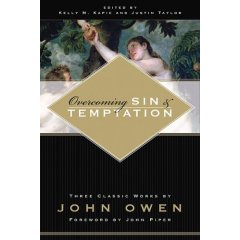
If you are interested in reviewing Overcoming Sin and Temptation (ed. Kapic and Taylor) and/or Suffering and the Sovereignty of God (ed. Piper and Taylor), here's what you can do:
  1. Send us an email at blogbookreviews@gmail.com, letting us know which book you'd like to review. (It's fine if you want both.)
  2. We'll email you a free PDF of the book(s). We won't send out any more PDFs after October 31, so please send your requests before then.
  3. If you post a blog review, then please cross-post it at Amazon.com.
  4. Then send us the blogreview link + your snail-mail address, and we'll send you a free hardcopy of the book(s).
If you want to read the entire book before you review it, that's great! But another suggestion would be to read and review three chapters from the Suffering book and/or the Introduction + just the Mortification book.

Happy reading and reviewing!

_________________________________________________________


For the record, I am doing this (got both books already downloaded, thanks Justin!) and have done this previously with Sex and the Supremacy of Christ (sorry about the formatting issues!) which was also a Piper and Taylor collaboration based off of the Desiring God National Conference of the same title.

Related Tags: , , , , , , , , , , , , , , , , , , , , ,

Wednesday, October 18, 2006

God's Grace - my Integrating Motif...


I am working on my Integrating Motif for my Senior Statement of Faith for Bethel Seminary (a requirement to graduate). Below is what I have so far (it is due on Friday) and I would be open to critique. We have to pick a major theological concept that has come to serve as an integrating motif for our faith, and will then use that motif as the frame work for our 18 page statement of faith (basically a summary of our complete theology). All of this goes before review by our professors/faculty at the Seminary. It's how they keep the heretics from graduating :-)


The word xaris in the Greek New Testament is translated as “grace”. We see from Romans 3:22-24, 5:15-16 that grace by definition is not something we have earned, it is given without expectation of repayment. We have not done and cannot do anything to compel God to give His grace. When we experience God’s grace we find a freeness to know God in our relationship to Jesus Christ (John 1:16-17).

The central theme to the Bible is God’s grace. We find this from the beginning to the end of the Bible. Genesis 1-2 tell of God’s gracious act in creating the world for the welfare of mankind. From there on we can trace the grace of God through the way He first dealt with sin in Genesis 3:16-22, to Revelation 22:17 where God is still inviting people to receive His grace.

God continually shows that He is a gracious God, forgiving people’s sins, sending his Son to die on a cross for people’s sins (John 3:16-17), and delivering those who do not deserve such kindness from their sins. God in grace enters into covenant relationships in the Old Testament as testaments to His grace (Noah in Genesis and Abraham in Exodus for example). In many other places as well God showers humanity with grace. Scripture continually reminds us that grace is a blessing given freely by God to those He has created.

Christ is the core expression of God’s grace for humanity. Through Christ’s atonement for our sins we are freed by God from the judgment and wrath that would rightfully be ours as a result of our sins. Christ’s work on the Cross fully reconciles through grace all those who would trust in Christ as Lord and Savior (Ephesians 2:8).

The role of grace in my own life cannot be underestimated. I daily need to rely upon grace as I continually sin. From this first hand experience of God’s grace I am able to understand how God’s grace plays out in other people’s lives, and in the church. The foundation of Christ’s church rests solely on God’s grace. The very nature and mission of the church is defined by grace. Without this grace the church falls into either legalism or liberalism, both of which reduce or remove the power of the work of Christ. The church (and thereby God’s people) is God’s chosen way to bring grace into the world.

God’s grace through Jesus Christ needs to be the central focus of my ministry. I need to teach, preach and model grace in ways that lead others to embrace and grow in grace. I desire to create an environment in my church where others can experience grace, and learn to share it with others. Through this multiplication God’s grace will be spread much further than I could ever do on my own.


Related Tags: , , , , , , , , , , , , , , , , , , , , , , , , , , , , , , , , , , , , , ,

Monday, October 16, 2006

An afternoon with a seeker...

I spent this afternoon talking with a man who I would dub as a seeker. My wife invited him over after he expressed some interest in talking about God. He is blind, and we see him walking past our house from time to time. We had a lengthy discussion about God 2.5+ hours, and he would like to talk again. Pray that God will work on his heart, that he will be more open to the Gospel, and that I (or whoever else he talks to next) will have the right words to share with him.

He was blinded a few years ago in a motorcycle accident and lives with his son who is a senior in a nearby highschool. He is very postmodern (in spite of being in his mid 50's) and is trying to draw from every religious stream. He is struggling through a contorted image of God. He is hung up on a good number of things in the Old Testament. We will be meeting again, he has invited us (my wife and I) over to his house for the next round.

Please pray for him and I (and my wife). We both need it.

Saturday, October 14, 2006

Transformational Church Series: 1st Baptist Church of Glenarden

Today I took the time to participate in Bethel Seminary's Transformational Church Series. It was great as always. This year the featured church was First Baptist Church of Glenarden. I have had the opportunity of meeting and interacting with the Sr. Pastor John Jenkins a number of times this past year through my work as the President of the Seminary's Student Senate. Pastor Jenkins serves on the Board of Trustees for the Seminary. I also had the opportunity to catch up with Justin Irving, whom I was a teaching assistant for last school year. I had not seen Justin since last May, so it was good to catch up with things about school and life. He passed on to me that while "Googling" his name, his mother found my blog!

A bit about First Baptist Church of Glenarden:
Pastor John Jenkins didn’t have to lead his thriving African American congregation to become part of the Baptist General Conference, a predominantly white fellowship. But First Baptist Church of Glenarden did just that, because of Jenkins’ conviction that "we need diversity—we need each other." And if Bethel Seminary and our constituency are to achieve our calling, we repeat his conviction: "We need diversity—we need each other." So we are thrilled to partner with First Baptist Church, host to Bethel Seminary of the East’s metro Washington, D.C. teaching center in Landover, Maryland.

From any biblical standard of evaluation, First Baptist Church is among those high-impact churches whose influence ripples in ever-widening circles—locally, nationally, and internationally.

* With more than 100 separate ministries, First Baptist Church reaches people and offers them the power of the gospel.
* Evangelism and discipleship lie at the heart of their ministry.
* First Baptist Church is a teaching church, where 1,000 pastors and leaders annually come for instruction and inspiration.
* Devotion to Christ, stewardship of resources, servant leadership, and broad participation of members are manifested in the growth of the congregation from 500 to 7,000 during the past 14 years.

Pastor Jenkins leads this transformational church with a powerful combination of gifts and values, including anointed preaching, unusual discernment in selecting outstanding staff, compelling vision, cross-cultural commitments, and astute implementation of strategic plans. He and nearly 30 of his key staff and leaders will join us for the 11th annual Transformational Church Series on Friday, October 13.

Related Tags: , , , , , , , , , , , , , , , , , , , , , ,

Thursday, October 12, 2006

Mark Driscoll on Glorifying God...

This morning (while avoiding writing a paper) I watched a sermon preached by Mark Driscoll. It covered the text of 1 Corinthians 10:23-11:1. It is an absolute must listen to (or watch via Vodcast) sermon. This sermon is so good that you need a copy, you need to burn a copy for friends and family members, and you need to give a copy of it to your pastor as well. He absolutely brings it on this one. The sermon is about Glorfying God (yes, he does reference John Piper toward the end of the sermon) and living as Christians in our culture. This is a sermon of great clarity, yet presented in a remarkably engaging fashion.

For those who don't know who Mark Driscoll is, I've copied his bio from his blog below:

Pastor Mark Driscoll was born in 1970 and raised Irish Catholic. He was born again in late 1989, married his high school sweetheart Grace in 1992, graduated with a B.A. in Speech Communications in 1993, and is currently completing an M.A. in Exegetical Theology at Western Seminary. He founded Mars Hill Church in Seattle in the fall of 1996, which has grown to almost 5,000 in one of America’s least churched cities and is one the nation's 60 fastest-growing churches. He co-founded and is President of the Acts 29 Church Planting Network, which has planted over one hundred churches in the U.S. and internationally, and most recently he founded and leads the Resurgence Missional Theology Cooperative. Pastor Mark has been named one of the twenty-five most influential pastors in America by The Church Report, one of the most influential young preachers in America by Christianity Today, Inc. (with over a million downloads of his sermons a year), and one of the twenty-five most powerful people in Seattle by Seattle magazine. Media coverage on Pastor Mark and Mars Hill varies from National Public Radio to Mother Jones magazine, Blender music magazine, Outreach magazine, Preaching Today, and Leadership magazine to ABC Television and the 700 Club. His writing includes two books; The Radical Reformission: Reaching Out Without Selling Out and Confessions of a Reformission Rev: Hard Lessons From an Emerging Missional Church. He is also a staff columnist for the Seattle Times, Rev! magazine, and The Church Report. Most enjoyably, Mark is the father of three sons and two daughters.


Related Tags: , , , , , , , , , , , , , , , , ,

Wednesday, October 11, 2006

A sad Pastoral story...


From ArgusLeader.com (my hometown newspaper):

Pastors from five mainline denominations criticized South Dakota's abortion ban Tuesday, separating themselves from their Roman Catholic and evangelical counterparts and ramping up a politically charged debate that already is influenced by strong religious undercurrents.

Representatives from a group called Pastors for Moral Choices said the proposed ban, which will be voted on Nov. 7, restricts religious freedom and would return the state to a "regressive, discriminatory and dangerous way of life." At a news conference in Sioux Falls, they said the ban was "neither just nor compassionate."

The group includes pastors from the Episcopal Church, the Evangelical Lutheran Church in America, the Presbyterian Church (USA), the United Church of Christ and the United Methodist Church.

Surprise surprise, a bunch of denominations that have abandoned the inerrancy of scripture (a high view of scripture) endorse the right to have an abortion.

The Pastors for Moral Choices statement said many Christian, Jewish and Muslim religious authorities believe abortion is permissible in the early weeks of a pregnancy.

Pregnancies that are the result of violence against women, including rape, incest and coercion, are especially complex and difficult.

"We seek to promote social policies that are fair, equitable and above all, merciful," the pastors said in a statement.

"A lot of pastors are conflicted right now just because they have people in their churches that have feelings on both sides of the issue, and it takes a certain amount of courage to stand up and say this is wrong," Hickey said. "I understand their points about women, but can't we love both the woman and the child?"

The Rev. Edward Goode, a Presbyterian pastor from Sioux Falls, said it's impossible to reach a consensus.
It's only impossible to reach a consensus when you have compromised the very foundation of Christianity, the Word of God. If the people in the pews are informing, and influencing their pastors on this subject something is desperately amiss. Yes, it takes courage to say something is wrong, that is the job of the pastor. Don't like it? God needs Christian burger flippers too. If the pastor cannot or will not make the tough calls the sheep have no shepherd. I find it interesting how the "pastor" considers abortion - the killing of an unborn baby - to be both merciful and equitable. Maybe we're not using the same language. It's clear we're not using the same hermeneutic and view of scripture.

Check out Abort73.com. (*Warning, that link has some strong content, but lives are at stake*)


Related Tags: , , , , , , , , , , , , , , , , , , , , , , , , , , , , , , , , , , , , , , , , , , , , , , , , , , , , , , , , ,

I love the snow...


I love the snow...just not today. I love snow because it reminds me of God's glory. Each flake falling from the sky in its individual form is a miracle. Watching heavy snow fall is very soothing, especially in the city. The snow absorbs all the sounds, makes the city somewhat quiet for a time. It also makes the city clean. Cities are generally ugly and dirty in my experience. The stale concrete, the trash on the side of the road, the smells and noise - they are like our sin. We are filthy. Even when we clean up or cover up, we still smell. The snow makes that look pure, clean, as we look to God if we have accepted Christ as our Savior.

Today it is snowing in Arden Hills, MN. It is not snowing hard, just a few flakes here and there. But it nonetheless reminds me of the grace that falls down on me. I cannot make it snow, and I cannot make the grace that I need, both are beyond me. And I am thankful for both, though not yet ready for the snow.

Related Tags: , , , , , , , , , , , , , , , , ,

Tuesday, October 03, 2006

Grace Driscoll on the role of women from the book of Ruth...


(HT Justin Taylor)

Grace Driscoll, wife of Mark Driscoll (and mother of their 4 children) of Mars Hill posed the following question: Is the biblical view of women applicable in our culture today?

She went on to answer that question in a remarkibly wise and graceful way.

Does what the Bible say about women really apply to us today in this culture (submission, can't be a pastor, weaker vessel, more easily deceived, etc.)? Doesn't it make us too vulnerable to our husbands? Doesn't it limit our ability to demonstrate our gifts? Doesn't it make us less of a human to just stay at home with the kids or take care of our husband? These are the questions I hear over and over from women. They are wrestling with how a loving, all-knowing God could possibly think that such antiquated ideas would work today.

The answers to these questions are clear in the Word, yet so seemingly unclear when compared to the yearnings of the culture around us. The more I study what God says for me to do as a women, wife and mother, the more peace I have in the roles God created for me. Through Ruth and various other verses, I will explore with you the clear principles that God has given us and the freedom in the methods by which we live them out.

After studying the Book of Ruth for the last few months, my understanding of submission, God's sovereignty, and Christ's redemption has been newly awakened as comforting truths.
For the full article go HERE. It is worth your time.


Related Tags: , , , , , , , , , , , , , , , , , , , , , , , ,

Sunday, October 01, 2006

I was a doubter...Minnesota Twins!!!


Today the Minnesota Twins defeated the Chicago White Sox, and the Kansas City Royals defeated the Detroit Tigers clinching the American League Central Division Title for the Twins.

The last week of May I had a conversation with a co-worker, where I stated I didn't believe the Twins had a shot at making the playoffs, let alone winning the division title. They were something like 12.5 games behind the Tigers, and 6 behind the White Sox who were playing very well. From that time the Twins went on a tear and won 71 of their next 104 games. WOW!

Congratulations to the Twins and to Joe Mauer who also won the American League batting title.


Related Tags: , , , , , , , , , , , , , , , , , , , , , ,

Saturday, September 30, 2006

I hate Minneapolis...


Yesterday I met Paul Schafer at the Hilton in downtown Minneapolis. Paul had flown in from Texas for the Desiring God National Conference (which is being live blogged by Tim Challies). I parked on 10th St. on the North Side of the Hilton at roughly 3:15 PM and went up to visit with Paul. Paul's room on the 17th floor marks the highest point I have been up in a building in downtown Minneapolis. We spied a Caribou Coffee a block away (next to Brit's Pub) and made our way there to talk. Paul and I had not previously met, though we had spoken once on the phone and interacted via email and on blogs for a couple of years. So we settled down and talked about life and ministry over a frozen coffee (Paul) and a bottle of water (me!). We eventually made our way back to the hotel, and went up into Paul's room to talk some more. It was a very nice time, and at about 4:35 we concluded with a prayer so I could make it to work by 5:00. When I left the building and made my way to the North side of the hotel, I discovered that my truck was no longer where I had parked it. Not good. Very not good. Immediately I called work to alert them to my pending difficulties to both getting to work, and getting to work with any work clothes (they were in the truck). I then called the Minneapolis Police to find out what to do. I explained what happened, where I was and asked what to do. I figured there was a chance it was towed and not stolen (I was praying for towed!). The police lady I spoke with was unable to find any listing of my truck having been picked up or delivered to the impound lot. She said it was possibly still in transition, or hadn't been processed yet. I asked if I should report it stolen or go to the impound lot, and her response was "it's up to you on that sir". Not a lot of help. I thanked her, and got off the phone to give it some thought (and to call and leave my wife a voice mail about my dillema). I went back out to where my truck was parked, and saw there was only a single car parked on the street, and the street was othewise very empty, with very little traffic for 4:45 on a Friday afternoon in downtown Minneapolis. The one car still parked on the street had a parking ticket on the window. I looked at all the signage on the street, nothing indicating that I shouldn't have parked there. Down the street was a sign with some handicapped stuff on it, but not near where I was parked. I looked at the meter I parked next to, and nothing on the side I put the money in. I looked on the street side, and in very tiny print was something saying "No Parking 4:00-6:00PM weekdays". So I had the doorman at the Hilton whistle me down a cab. I asked the driver to take me to the impound lot, which was about a mile away. $6.68 later and I'm at the impound lot. I tip the driver, who was working on some fractions on a notepad while he drove. They were simple fractions, things learned in 4th or 5th grade. I suspect he is working toward his citizenship, but I don't ask. I don't want to pry, and I'm focused on truck recovery. My computer is in the truck, with all of my past 4 years of seminary work on it. My text books are in there. Many of my CDs, my work clothes, a ton of tools. I really want my truck back.

I enter the impound lot, and am dissappointed. The building appears to be built to be bomb proof. I suspect this is because 99% of the people entering here are VERY unhappy people. Thick glass seperates you from the employees, like a gas station in the bad part of town. It has to be a terrible job I think to myself as I watch a very elderly man try to get his car out of the pound. I can see he is in poor health, and is very likely not able to afford this situation. In fact, everyone in the room looks like they probably are not in the best of financial situations. 2/3 of the people are black women, there is 2 groups of Latino men, and one other young white woman, and the old man. We're all in this together in some warped way.

I stand in line, watch other people's pain. Eventually I make it to the front of the line, but my truck has not come in yet. I'm getting worried. It is now 5:20, and my truck is nowhere to be found. I decide to give it another 20 minutes, then I'm calling it in as stolen. 15 minutes later a man from behind the thick glass motions to me and calls me over. He tells me it's my turn, and I begin to explain my truck hasn't come it yet. He says it just did, and they are finished processing it. $138 in tow fees, $34 in parking ticket later and I get the piece of paper that says I can take my truck. I then have to wait 20 minutes for the "security" to come pick me up and drive me 150 yards onto their lot to my vehicle. No foot traffic is allowed, all persons must be accompanied by security. I make it to work around 6:30 PM, missing some of the most profitable time of my shift. All told, the expense for parking was $2.50 in the meter, and then at least $200 for the last 5 minutes. 5 minutes. My truck was towed at 4:05 PM.

I hate Minneapolis.


Related Tags: , , , , , , , , , , , , , , , , , , , ,

Friday, September 29, 2006

Culture: Friend, Foe, or...?

Phil Print of Crossroads Church in Cottage Grove, MN wrote:
I'm speaking to some pastors about our relationship with our culture next week...how we (the church) view it and how we live in it. Some see 21st century American culture as the enemy, and they declare war on it (culture wars). They develop a "circle-the-wagons" mentality and isolate and attempt to insulate (think Amish here) themselves from culture. Other Christians and churches seem to go with the flow. They immerse themselves in culture and end up essentially no different from anyone else. They look, think, and act like everyone else.

I'm guessing we all would fall somewhere between those extremes (I hope). I know we're called to NOT copy the behavior and customs of the world. It's also clear, though, that we are to penetrate our culture in order to impact people for Christ. My point: I don't see our culture as a battlefield. I see it as a mission field. The difficult part is how we engage this post-Christian culture...how we live out what the Apostle Paul modeled for us in Acts 17:16-34 and 1 Corinthians 9:19-23.

Insights?

My response:

Phil,
Are you familiar with H. Richard Niebuhr? Niebuhr felt that there were 5 types of interaction between Christianity and Culture (see half way down the page in that link). While it isn't exactly within the framework of what you are talking to the pastors about, I think it is still relevant. It is something that made me think (though I don't necessarily completely agree with Niebuhr on a number of theological points). A book you might find useful is "The Church between Gospel and Culture - The Emerging Mission in North America" Edited by George R. Hunsberger and Craig Van Gelder - WB Eerdmans Publishing. There are a number of articles in there speaking directly to what you are thinking/talking about. Bethel should have a copy.

At the end of the day Christianity must be translatable to the culture we are reaching out to. This is true for foreign missionaries and for meeting our neighbors in our back yards. Christianity is compatible with all cultures, which is why we translate the Bible into the vernacular (though this hasn't always been the case WRT the Roman Catholic Church). Islam is not, and it continues to use a single language as it's "divine" language. Our God is the source of life and truth, and because of that we have contact points in every culture, places we can bridge to. While doing this, we must of course keep in mind that we are in the world, not of it (1 Cor. 7:29-31). The process of translating the Gospel into the culture does not mean we must seek to annihilate that culture, but we should maintain a critical attitude so as to not become syncretists. We must ride the razors edge between rejecting a culture and fully embracing a culture, because it is easiest to fall to either side. Staying in this point of tension is going to be uncomfortable at times, but it is where we are called to be if we are to reach a lost and hurting world. I believe Paul was an advocate of this very thing. He did not see there being a single culture favored by God. He ministered across many cultural boundaries (as did Christ). Paul is key in understanding this because he led the Gentile breakthrough which was an enormous paradigm shift for the early Jewish Christians.


In summary, there are points where our culture (and other cultures) are both battlefields and mission fields. There are segments of cultures that are diametrically opposed to Christianity, and that must be rejected or Christianity looses its distinctions, and the Gospel looses its life changing powers. But we cannot completely disregard a culture, or we become fully irrelevant and are unable to bring the Gospel to the world as we are clearly commanded to do in scripture.


Update: Justin Taylor has some relevant info to this subject from an article written by Don Carson.

Related Tags: , , , , , , , , , , , , , , , , , , , , , , , , ,

Thursday, September 28, 2006

Desiring God moving away from Radio

Radio Without Radio?

Why Desiring God Will No Longer Air on Radio Stations

September 12, 2006


Dear Friends,

We want to inform you about a major ministry transition that will occur at the end or September. The DG Board and Management Team believe that the Lord is directing us to redeploy our forces and resources on battlefronts where they will be more effective in winning the war. Therefore, after much prayer, research, and discussion, we have decided to cease broadcasting our radio program on traditional radio stations. The last day our program will be aired is Friday, September 29, 2006.

Now, just to be clear, we are not ceasing to broadcast our program. We will continue to produce Desiring God with John Piper. But instead of airing it on traditional radio stations, we will broadcast it on the internet and with alternative media like podcasts.

Radio without radio stations? Why? The first reason is because of a change in radio that is taking place, and the second reason has to do with investing resources strategically as this change occurs.

Radio Is Changing

We currently air the program on about 160 radio outlets around the country. We also broadcast it at desiringGod.org, OnePlace.com (a website featuring many evangelical teachers) and as a free podcast at iTunes.com. Now here’s the interesting thing. The folks at OnePlace.com tell us that Desiring God is among their most requested programs (50,000 to 70,000 requests per month). And our iTunes podcast consistently ranks in the top ten most requested programs in the “Religion & Spirituality” category (total subscribers currently unavailable). We frequently hear from online listeners. In fact, 85-90% of responses we receive from people who listen to our program come from those who listen online. But we’re not seeing growth in responses from radio station listeners, even though new stations were added this year.

Why is this? Well, there are a number of reasons. But one simple fact is that radio is changing. Just a few years ago traditional radio was still the best way for a ministry like ours to make our message accessible to the largest number of people. But we are finding that this is no longer the case. A rapid technological evolution is occurring. Five years ago most adults in the U.S. did not have access to the internet. Today most use the internet regularly and most have broadband access. Five years ago few regularly used portable MP3 players. Today the popularity of these portable devices is skyrocketing. 59 million iPods have been purchased since October 2001—30 million of those so far this year! What’s happening is that more and more listeners are choosing these new technologies over radio so that they may listen to teaching programs whenever and wherever they wish. This is especially true of those under 50 years old, who comprise the great majority of our listeners.

Spreading and Stewardship

Our calling from the Lord is to put our resources into as many hands, ears, and eyes as possible, while using our resources most strategically, so that people around the world will be transformed by the truth that God is most glorified in us when we are most satisfied in him. So there are four words that shape our strategy:

* Accessible: We want people to have convenient access to as many of our resources as possible. Our new website has been designed for this purpose.
* Portable: We want our resources, whenever possible, to be in a portable format, so that you and others can read, listen, or view them where and when it’s convenient for you.
* Transferable: We want many resources that you can easily pass along or show to others, so that the vision of God we love together will most effectively spread.
* Economical: We are pursuing strategies that we believe will be the most effective at spreading a passion for the supremacy of God, while keeping our costs and prices low.

In light of the changes in radio, and these four criteria, radio station broadcasts no longer seem like the best use of our personnel, time, or financial resources. Our radio broadcast has limited accessibility—it only plays where and when stations are airing it. Radio is generally portable, but you can’t choose when you will listen to what. And radio is not nearly as transferable as an internet broadcast for passing along to someone else.

But the economical criterion clinches it. Altogether it currently costs us about $500,000 per year to broadcast our program on about 160 stations. When we launched our program in February 2004, we were told to expect stations to support themselves through the financial gifts of listeners in about three to five years. However, after two-and-a-half years, our total radio-designated support is about 35% of annual station costs. And the growth trend is so gradual that it appears station broadcasts would need to be subsidized indefinitely by the generosity of supporters who do not listen to the program on the radio. This makes the prospect of putting the program on new stations very difficult.

Here is another way to view the strategic spreading difference between the internet and radio. In 2006 we expect to have over 12,000 new people respond to us because of our internet outreach. But it currently looks like we will only about 500-600 new people will respond because of radio. Therefore, in light of the low listener response and the high broadcasting costs of traditional radio, we believe that it would be wise to take what we are investing into stations and redirect it toward other creative spreading strategies that will reach thousands of new people more effectively.

Radionet Lives On

It is important to emphasize that we are not abandoning what we sensed was a call three years ago to broadcast a radio program. What we’re doing is responding to what we see the Lord doing, namely opening new technological doors for the spread of the gospel. Three years ago we called our strategy “Radionet.” The idea was to use radio to reach new people and point them toward all of our resources on the internet. We still believe in the idea. But because listeners are bypassing long-form teaching programs on the radio, we want to use that spreading tool in other ways.

One possibility we are researching is 60-second spots that would air on all sorts of radio stations. Many stations play such short-form programming for free. The spots would give listeners a brief, compelling word from Pastor John and encourage them to go to our website for more information. Pray with us as we discern the Lord’s direction for this and other possibilities.

Though it will relieve some financial pressure, this change in radio strategy does not mean that we no longer need financial support. Under God’s providence, our friends make it possible for us to extend the glorious gospel of our happy God to thousands. So now, with broadcasting fees no longer being paid, we can allocate funds to more effective strategies.

Thank you very much for standing with us in the spiritual war. Battlefronts and tactics change, but our mission does not. We consider it a great privilege to join with you in seeing as many people as possible freed from the suicidal slavery of selfish pleasures to enjoy the freedom of the Son of God and the true pleasures at his right hand. If you have any questions you would like to ask or comments you would like to make, please don’t hesitate to contact us.

If you would like to give us your views on how we can improve the program in our move to online only broadcasting, please take our survey.

Your partner in spreading a passion for the supremacy of God,

Jon Bloom
Executive Director

Related Tags: , , , , , , , , , , , , , , , , , , , , , , ,

Monday, September 25, 2006

Rich Mullins on Wikiquote

To this day, Rich Mullins is my favorite Christian musician. His death is among the few I will forever remember where I was and what the circumstances were when I first heard about it. That moment in time is frozen for me. I miss the man that was Rich Mullins. I wonder if God will give him a dulcimer to play in Heaven? :-)

_______________________________________________

Richard Wayne Mullins (October 21, 1955 – September 19, 1997) was an American singer/songwriter born in Richmond, Indiana.

* "Never forget what Jesus did for you. Never take lightly what it cost Him. And never assume that if it cost Him His very life, that it won't also cost you yours."

* "So go out and live real good and I promise you'll get beat up real bad. But, in a little while after you're dead, you'll be rotted away anyway. It's not gonna matter if you have a few scars. It will matter if you didn't live."

* "It's so funny being a Christian musician. It always scares me when people think so highly of Christian music, Contemporary Christian music especially. Because I kinda go, I know a lot of us, and we don't know jack about anything. Not that I don't want you to buy our records and come to our concerts. I sure do. But you should come for entertainment. If you really want spiritual nourishment, you should go to church...you should read the Scriptures."

* "We do not find happiness by being assertive. We don't find happiness by running over people because we see what we want and they are in the way of that happiness so we either abandon them or we smash them. The Scriptures don't teach us to be assertive. The Scriptures teach us—and this is remarkable—the Scriptures teach us to be submissive. This is not a popular idea."

* "I had a prof one time... He said, 'Class, you will forget almost everything I will teach you in here, so please remember this: that God spoke to Balaam through his ass, and He has been speaking through asses ever since. So, if God should choose to speak through you, you need not think too highly of yourself. And, if on meeting someone, right away you recognize what they are, listen to them anyway'."

* "I think if we were given the Scriptures, it was not so that we could prove that we were right about everything. If we were given the Scriptures, it was to humble us into realizing that God is right, and the rest of us are just guessing."

* "Christianity is not about building an absolutely secure little niche in the world where you can live with your perfect little wife and your perfect little children in your beautiful little house where you have no gays or minority groups anywhere near you. Christianity is about learning to love like Jesus loved and Jesus loved the poor and Jesus loved the broken."

* "Bear in mind, children, that they listen to you because you are kids—not because you are right. That's how our Father listens to us."

* "We never understand what we're praying, and God, in His mercy, does not answer our prayers according to our understanding, but according to His wisdom."

* "Yes, it's embarrassing to be born again, but imagine how embarrassing it must have been to be born the first time. At least this time you get to wear clothes!"

* "We are not saved because we're good. We're good because we're saved. Never forget what Jesus did for you."

* "If you've ever known the love of God, you know it's nothing but reckless and it's nothing but raging. Sometimes it hurts to be loved, and if it doesn't hurt it's probably not love, may be infatuation. I think a lot of American people are infatuated with God, but we don't really love Him, and they don't really let Him love them. Being loved by God is one of the most painful things in the world, it's also the only thing that can bring us salvation and it's like everything else that is really wonderful, there's a little bit of pain in it, little bit of hurt."

* "It's just that for so many people that I know, Christianity's this matter of ... it has everything to do with morals. Christianity is a religion about morals. And they will even talk about Jesus. And they will say kids need to know about Jesus so they won't smoke, drink, or dance, or go with girls that do, and all that kind of thing. And I kinda go, 'That's not why people need to know about Jesus. The only reason—the only possible excuse for talking about Jesus is because we need a Savior.'"

* "I am a Christian, not because someone explained the nuts and bolts of Christianity to me, but because there were people willing to be nuts and bolts."

* "If you want a religion that makes sense, go somewhere else. But if you want a religion that makes life, choose Christianity."

Retrieved from "http://en.wikiquote.org/wiki/Rich_Mullins"

Related Tags: , , , , , , , , , ,

Tuesday, September 19, 2006

Where's God?

Pastor Phil Print asked the following on his blog:

Where's God?
Do you ever wonder why God doesn't make it a little easier for us to see/experience Him in our daily lives? Honestly, couldn't God be a little more "obvious"? Couldn't He use a little louder voice? Or hit us with a little bigger stick?

I've been thinking about that a lot these days. William Barry writes, "Whether we are aware of it or not, at every moment of our existence we are encountering God, Father, Son, and Holy Spirit, who is trying to catch our attention, trying to draw us into a reciprocal conscious relationship."

I know what Barry says is true, but why is it such a struggle to encounter God?

Thoughts? Comments?


My response to his question was:

The issue stems from a Western modern dualism that can be seen manifesting in many other ways as well. We are prone to compartmentalize our lives by secular and sacred when this is actually a false dichotomy. This is worsened by something you mentioned in your sermon(9/16 or 9/17) in that we get so busy that we miss the God moments. The struggle to encounter God is based on the fact that encountering God is not a priority in our lives. We shove God to the cracks and margins of our lives. Our prayer life becomes a wishing well in the sky. Michael Jordan didn't become the basketball player we know him as over night. He worked hard at it, years and years of INTENTIONAL effort. While he certainly was gifted by God, it took intentionality on his part to develop that. The same is true for our spiritual formation. We must be intentional about it. Spiritual formation doesn't just happen on its own, we must work at it. We must raise its value in our community. This is also worsened by our microwave lifestyle where everything is about instant gratification. We don't want to be formed, we want to get the DVD and have all the answers 90 minutes later. Another factor is that we are not accountable in this area, and rarely are we willing to hold others on a personal level accountable for this. We (the church) speak corporately about these kinds of things, but rarely do we have a 1-on-1 plan for getting this done. Small groups are a very good entry point for this type of change. Making friends in your church will also help this. Moving from a consumer mentality into a servant mentality will also facilitate this. It will be an uncomfortable transition, change frequently is. But when you are standing on the other side, standing more closely with God, seeing His influence and presence in your life, you will know it was all worth it.

What do you think?

Related Tags: , , , , , , , , , , , , , , , , , , , , ,

Saturday, September 16, 2006

Jim Collins - Good to Great for churches...

The following is taken from an article in Christianity Today's Leadership Journal. This comes from an interview with Jim Collins. Collins wrote "Good to Great" and "Built to Last", both of which are books worth your time if you want to learn about leadership (espeically Good to Great).

_______________________________________

The subtitle for your monograph is "Why business thinking is not the answer." How is business thinking misapplied in the social sector?
The mistake social sector organizations often make is to implement "business practices," but they imitate mediocre businesses.

For instance, bringing in an outside change agent. That's what many average companies do, but great organizations have the discipline to grow leadership from within. There's also the practice of using incentives. Average companies spend a lot of time incentivizing desired behavior. Great institutions discipline themselves to get people whose character is naturally to exhibit great behavior.

Since discipline is so key, where do you most often see breakdowns in discipline?
Not being rigorous about who's put in leadership roles. In churches and other social sector organizations, the work is too important to let key seats on the bus be occupied by the wrong people.

Second is being unclear about your goals. You must ask, "What do we mean by great results?" Your goals don't have to be quantifiable, but they do have to be describable. Some leaders try to insist, "The only acceptable goals are measurable," but that's actually an undisciplined statement. Lots of goals—beauty, quality, life change, love—are worthy but not quantifiable. But you do have to be able to tell if you're making progress. For a church, a goal might be: Young people bring other young people here unprompted. Do they talk about the church with their friends? You may not be able to measure that, but you can assess it.

Third is undisciplined action, most commonly seen in the inability to stay with a coherent program long enough to get flywheel momentum.

Average organizations constantly lurch from one initiative to another. They're always looking for the next big thing, when the next big thing might be the thing they already have.

What role does leadership play in great churches?
One of the things from Good to Great that really resonated with church leaders was the Level 5 Leadership finding, that leaders who took companies from good to great are characterized by personal humility and by a fierce dedication to a cause that is larger than themselves.

I was delighted how the Level 5 concept took hold, and yet the deeper I got into it, the more I realized that Level 5 Leadership looks different in a non-business setting. A church leader often has a very complicated governance structure. There can be multiple sources of power, constituencies in the community, and constituencies in the congregation. With all of that, you're going to run into trouble if you try to lead a church as a czar. Church leaders have to be adept in a more communal process, what we came to call "legislative" rather than an "executive" process.

Related Tags: , , , , , , , , , , , , , , ,

Thursday, September 14, 2006

Lee Strobel is coming to Eagle Brook Church!

The following hit my inbox today from Pastor Bob Merritt of Eagle Brook Church. Even if you don't go to Eagle Brook Church this event is worth checking out. Lee Strobel is an outstanding writer and is very engaging in his presentations.


Men of EBC,

I want to let you know about a "don't-miss" event that is coming up in just a couple of weeks. We are hosting nationally-known speaker and author Lee Strobel (Case for Christ and Case for Faith) at an event built just for men on September 26 at 7 pm at Eagle Brook's Lino Lakes Campus. Lee is a former award-winning legal editor of The Chicago Tribune who went on a two-year investigation trying to find truth, and came to the life-changing verdict that God really does exist and Jesus Christ is his unique Son. Through this search, his life was changed-and you'll get to hear more about it on this night. We have some amazing things planned, with Lee speaking and Steve Duede leading our music. I'd like to challenge all of you to go online and buy two tickets; one for you and one for a friend at work, a teammate or a neighbor. Ticket prices go up after this weekend, but if you sign up soon they're just $10. Follow the link below to register.

http://eaglebrookchurch.com/ministries/men/mainevents.html

Hope to see you there,

Bob

Related Tags: , , , , , , , , , , , , , , , , , , , ,