Monday, March 13, 2006

A day late...


It snowed. A lot. A whole lot. We lost power in East St. Paul twice early this morning because of the snow. I went out and started shoveling at 6:30 AM so my wife could get her car out of the garage, down the alley and to work. By 7:30 I had cleared from one end to the other, but during that hour another couple of inches fell on what I had just cleaned. I went in and had breakfast, and by the time we came back out to leave at 8:30 there was 5+ inches now covering what had been my clean driveway. The drive to campus that usually takes me 40 minutes on a Monday morning took an hour and 20 minutes. I passed cars, trucks, Semi's and Busses in the ditch.

The funny thing is, we've been planning on buying a snowblower with the money from our wedding. We've been waiting for the Spring sales. I think we were a day late.

Related Tags: , , , , , , , , ,

Sunday, March 12, 2006

CrossRoads Church

Today we made our way down Hwy. 61 to Cottage Grove and visited CrossRoads Church. I was surprized at how quickly we had gotten there from where we live. It's a straight shot following the river 10 miles, one left turn, go 2 miles and pull into the parking lot.

I had never been to this church before, and as I pulled in, I could see already that they were in need of a new building. Not because anything was wrong with this facility, but because I know how many people they've been packing into this place on a weekly basis, and at first glance, I knew they were constrained by space. Once inside we found a very inviting atmosphere. The people were friendly, the signage was adequate, and there was a cool promotional running in the lobby for Covenant Pines Church Camp. We were greeted at the door with a handshake, and everyone we talked to seemed open and inviting. They also have really good free coffee. And cookies. Chocolate Chip cookies. M&M's Cookies. Did I mention they were free? And quite yummy.

The crowd was late arriving, most pouring into the sanctuary for the 11:00 service in the last 5 minutes. We got in early and got seats near the front where I like to sit, and by 11:00 there were nary a seat to be found empty. I would guess 90% full from what I could see. It was a FULL house. I learned at the end of the service they have started a new building campaign that will be a great improvement for the operations of this church when completed.

The worship was solid. It wasn't at the level of Eagle Brook Church, but few churches are. My wife (Banana) especially like their selection of songs. The stage was surprisingly small, and it felt a bit cramped for the band and singers. I am all to familiar with this from my time in Northridge Baptist Church (the old building) on the worship team where we nearly stood on top of the bass guitarist amp/half stack for lack of space.

Phil Print preached on Joshua 2, the story of Rahab the Harlot. Phil absolutely rocked it, and I expected nothing less quite honestly. Phil is enormously gifted in preaching, and I was blessed to sit in on his message today. In just one message I saw dozens of things I could do better as a communicator of the Gospel. Very humbling. Banana found the fact that Phil had made this message fairly interactive with the congregation very interesting. She said she hadn't experienced a service like this before. Phil's message was longer than I was expecting, and each and every moment of it was good stuff. The main point that he made was that God's mercy and grace is far greater than anything in your past, and that Jesus shed His blood so we can be freed from our past. Phil is right. God is more interested in our future than our past. Phil built up his main points with verses from James 2, Hebrews 11, Matthew 1, Revelation 1, Ephesians 1, and Isaiah 1. All verses were enormously relevant and placed exactly where they needed to be in the sermon. A message crafted at a level I only dream of reaching.

After the service I had the opportunity to speak with Phil for a few minutes before we left, and I was reminded just how great a man he is. CrossRoads Church is very fortunate to have someone who is so gifted, yet remains enormously humble. Phil has assembled a very talented team around himself, and I believe CrossRoads Church is going to be used in big ways by God over the next few years. If you are in the SE Metro of Minneapolis/St. Paul, I highly reccommend you stop by and visit CrossRoads Church and see how God is working in this community and church.

CrossRoads Church
7955 IvyStone Avenue South
Cottage Grove, MN 55016
Phone: 651-459-7111
Fax: 651-459-1561


Related Tags: , , , , , , , , , , , , , , , , , , , , , , ,

Pastor Phil Print is blogging...

I just discovered one of the pastors I have been a Teaching Assistant for at Bethel Seminary has started blogging. Phil Print is one of the best communicators I have ever heard. He is truly gifted in preaching and teaching, and has an intense fire that burns within to see God's Kingdom advanced at a level few others posess.

Phil is the senior pastor of CrossRoads Church in Cottage Grove, MN (a SE suburb of St. Paul). My wife and I will be attending church there this weekend, and I'll post about our experience. CrossRoads is an Evangelical Covenant Church.

Their current series they are preaching is:
Going for the Gold - As Christians we dream of a different reward—receiving God’s blessing and hearing God’s applause. How do we live the kind of life that God rewards? How do we “go for the gold”? As we study the lives of several characters from the Old Testament, we’ll uncover the answer. We’ll find out what it takes to be one of God’s gold medal winners.


Related Tags: , , , , , , , , ,

Friday, March 10, 2006

Tithing Dispute


(from FotF's Pastor's Weekly Briefing)

The majority of Protestant ministers (56%) believe that Christians should tithe 10 percent of their income to their local church while only 36 percent of church members hold that view, according to a new study conducted by Ellison Research and released last week by Facts & Trends. Almost one-in-four churchgoers (23%) believe that the Bible commands them to tithe, but not necessarily to their local church. Only 12 percent of clergy feel the same way. The research, conducted among 811 Protestant ministers and 1,184 adults who attend a Protestant church at least once a month, also revealed that 10 percent of Christians believe that they are under no mandate to give anything.

Similar studies over the years have consistently shown that while 60 percent of churchgoers believe that tithing is a biblical directive, fewer than 10 percent actually tithe of their income. "In other words, at least half of all Protestants are clear on what they're supposed to be giving, but consistently don't give it," said Ron Sellers, president of Ellison research.

Other key findings from the study:

* Disaster relief is the most common type of cause (outside of the local church) that is supported financially.
* The average churchgoer directs 31 percent of their giving to organizations outside of their church.
* In the last year, two-thirds of clergy have given to promote evangelistic causes outside of their own church. Only one-third of laity have done so.

Complete report can be found at www.ellisonresearch.com.

Related Tags: , , , , , , , , , ,

Wednesday, March 08, 2006

Homosexuality A Christian Response

The following was published in "FOCUS" a magazine for Bethel Alumni. On April 18 the gay activist group called Soulforce will have their Equality Ride visiting Bethel's University's campus.
(Please ignore formatting issues. I didn't want to manually edit the whole document in html so it's a bit erratic)
____________________________________________

The Panelists

James Beilby, M.A.T.S.,
Ph.D.,
associate professor of biblical and theological studies; a frequent speaker on theology and contemporary culture
Michael Holmes, M.A.,
Ph.D.,
professor of biblical studies and early Christianity and chair of the Department of Biblical and Theological Studies
James Koch, M.A., Ph.D., professor of psychology; director of counseling
services
Sherry Mortenson, D.Min., associate dean of campus ministries and pastor of spiritual formation
Jenell Williams Paris, Ph.D., associate professor of anthropology, author and researcher in the field of sexuality

We hear a lot of talk today about sexual identity and orientation. Could you
bring your perspective to this emphasis in our culture?

Holmes: The Apostle Paul [in the New Testament] nowhere discusses homosexuality
as an orientation. He discusses behaviors, and he never discusses them in isolation.
When he talks about same-sex behavior it’s in the context of opposite-sex
behavior as well. Paul has a category in which sex is rightfully exercised
and enjoyed—in marriage between a man and a woman—and another category
in which it’s not: for those outside such a marriage. His categories
are not heterosexual and homosexual; they are married or unmarried. We impart
so much of our culture into the way we read the Bible that it keeps us from
hearing the text.

Paris: While same-sex sexual behavior has long been recognized, “heterosexual” and “homosexual” as distinct human identities is a social construct that comes out of 19th century, maybe a little earlier. Sexual identity is not a biblical concept, and I don’t think this concept is true to the way God made us. Not many cultures have said sexuality is so important that, beginning in childhood, you need to explore it and think about it, and you can’t be a healthy adult without expressing and knowing it. That, in my view, is a sign of a culture that has made an idol of sex.

Is it even useful, then, for Christians to talk in terms of sexual identity?

Paris: Because we live in society, we have to engage this construct of orientation and work with it strategically, even though as Christians we don’t have to live by its power.

Koch: As a psychologist, I think it’s a valid concept. There are some
people who have a predisposition from a very early age. For others it’s
an evolving process. But as a society, and even as Christians, we confuse early
feelings of same-sex attraction with permanent orientation. When you flatten
those categories, it creates a tremendous amount of confusion for a young person
in development. Data today show young people are labeling themselves sexually
at age 15. Anyone in the midst of uncertainty is told what label to apply.
For some it feels like liberation, but for others it becomes a prison. I think
of my experience in high school compared to my kids’ experience and the
gay groups that are very mainstream now. It’s all part of an early labeling
process.

Does the scientific community agree on causes, and how should that shape our
thinking as Christians?

Beilby: When we let culture define the categories for us, then we’re
forced into false either/ors. One of the fairly offensive things the Christian
community has done with respect to this issue is to say, “Well the Bible
says it’s wrong, therefore it was a person’s bad choice. People who are homosexuals are suppressing the truth.” It’s not that simple. There might be choices associated with sexual orientation, but it’s not one single choice. On the other hand, neither is it simple determinism either: “I am created to be this way.” Studies have shown there is not one single set of factors that creates homosexuality. Whatever it is—a complex mixture of potentially genetic factors, potential brain biochemistry, early experiences, and responses to those—may be precursors. But they do not remove the person’s moral responsibility any more than a person hard-wired with
a Type A personality does not have to resist their inborn inclination toward
arrogance. Mere desires are not a good indicator of right and wrong.

Koch: The fact that we have appetites and desires is part of who we are and
how we’re constructed. Having said that, if we are searching for a way
to understand those desires, we will draw meaning from our context. And if
that context is ill-defined, we need something to help guide our interpretation.
That’s where Scripture comes in. That’s where Lordship and discipleship
come in, because we are encouraged to bring our desires under the Lordship
of Christ. When we do, we’re growing into the creatures God made us to be.

How would Bethel respond to a student struggling with homosexual desires?

The stance of Bethel University on homosexual expression remains clearly stated in a covenant that students, faculty, and staff agree to honor: “We believe that sexual intercourse
and other forms of intensely interpersonal sexual activity are reserved for monogamous, heterosexual marriage.”

Mortenson: Because we are a Christian liberal arts university, we look to the Word as our beginning place. The standard is the same for all relationships. The expectation in our community is that if we are not [heterosexually] married, we are celibate. I would minister to a student feeling same-sex desires in the same way I minister to students who come and say they’re addicted to pornography or are having sex with their boyfriend or girlfriend. I respond with truth, grace, and compassion, but also within the context of who God has called us to be as holy people.

Koch: Bethel’s position is, if you are struggling with same-sex attraction
or believe yourself to be homosexual in primary orientation, that is not a
sin. The issue is how that person or any of us lives our lives morally. If
someone is struggling with questions of sexuality at Bethel, there is room
to talk it through, whether through counseling services, with faculty, student
life, or campus ministries. We want Bethel to be a place where students know
they can work on this issue.

Paris: I would encourage anyone to work out their holiness and morality, with Scripture, in community with other Christians. What I’m afraid of is sounding like that isn’t concrete enough. It’s so sad to me that compassion and acknowledging the complexities of real life, when we’re
talking about sexuality, can sound liberal as though we’re not taking a conservative stance. Do we have to articulate hate or shunning or judgment in order to be proper conservatives? That’s just terrible if that’s the case. I’m taking my cues from John Wesley in Methodism where a healthy model for that student or anyone at all working on their sexuality would be
small groups of people meeting to pursue personal holiness together.

When should a Christian community discipline a homosexual individual by separation or other steps described in 1 Corinthians 6?

Beilby: A community that doesn’t talk about accountability is not a
biblically faithful community. But at the same time we also talk about grace—that
we’re all unfinished products and no sin is worse than any other. My
inclination is probably we’re not going to find one nice, neat principle
that we can apply in every single case. It has to be dealt with on a case-by-case
basis. But whatever we say in any given case, the emphasis on discipline has
to be consistent. It can’t be something we practice with respect to homosexuality
alone.

Holmes: Falling short in one area, such as the prevalence of divorce in the
church, does not justify giving up biblical standards in other areas. We are
called to uphold biblical standards with an equal hand. However, the church
also needs to recognize that it’s got to do a much better job of providing
resources for people to deal with the kinds of situations they find themselves
in. The church has tended to say, “Just say no,” and drop it without seeking to
provide the help, the discipleship, the support to find alternatives—particularly
in a culture that says you must be sexually active to be human.

Mortenson: With the issue of sexuality, I hear students who want to
know how far they can go. And I think whether we are struggling with heterosexual
or homosexual desire, we ask the wrong questions. We need to be asking “How
can I be someone who is holy and pure? How can I be someone whose life is a
reflection of my faith and commitment to the Lord?”

Some Christians believe that everyone with a primary homosexual orientation
can change to become heterosexual. What is your response?

David Clark, M.A., Ph.D., lead faculty in the M.A. in Christian Thought at Bethel
Seminary, moderated the first of the two faculty forums that wrestled with
the issue.

Koch: People wrestle with many conditions involving a physiological component
that do not fundamentally change throughout life. For some homosexuals, there
has been a change in orientation. I believe God’s grace works in this
world in many ways. But generally, if someone’s orientation is predominantly
same-sex and reinforced by circumstances, it is more difficult to become primarily
heterosexual. On the other side, if someone’s motivation is strong, if they’ve had successful heterosexual functioning and were not confused about gender identity in early childhood, that increases the likelihood that, yes, a change in orientation could occur more easily. In the field of psychology, we need better research.

Holmes: In this matter, as in many others, God’s grace comes to His
people in different ways. Paul himself prayed for deliverance from a “thorn
in the flesh,” but God’s answer in his case was, “My grace is sufficient for you, for my power is made perfect in weakness” (2 Cor. 12:9). Similarly grace comes to some people in the form of deliverance, and to others in the form of a disciplined endurance. In both cases God’s grace is at work, in different ways. To expect that everyone will live in conformity to scriptural standards is biblical; to expect or claim that everyone will experience grace in exactly the same way is to infringe upon God’s sovereignty.

Paris: I’ve been paying attention to this field for about 15 years,
and it’s not a simple answer. If anything, academic and Christian dialogue
about it increasingly recognizes how complex sexuality is. So I think there’s
a practical question: What should we as Christians try to do about friends
or acquaintances who are homosexuals? Jesus was very straightforward about
our responsibility as Christians: we are to love others as ourselves. It’s
that simple. And whatever healing or change might happen for the homosexual
is up to that person and the Lord’s healing in their lives.

How are Christians to regard others dealing with longing or loneliness because
of persistent same-sex desire? Is that what a loving God would want?

Mortenson: I once heard two Christian women talking. One said to the other, “You
must be very proud of your son. He’s so successful.” And the mother replied, “Yes, I’m proud of that son, but I’m also very proud of my other son. He’s a homosexual and he’s living a celibate lifestyle. He brings such joy to my life.” And I thought what grace this mother was giving to her son! Also, I was a single person in the Bethel community until I was 35 and lived a celibate lifestyle. I never once thought that God did not love me or that I had less value.

Paris: It’s not easy to live without sexual fulfillment. But we learn
more about how to live with deep longing from Jesus than we learn how to get
all our needs met. And I think for gay Christians, however they work out their
sexual desire over time, that is part of their discipleship. If that includes suffering, that suffering is part of what they offer to God.

Koch: Even in psychological theory, well-being does not hinge on sexual fulfillment. When we place that in some way center stage, we do a disservice to our development as whole persons and really skew the discussion.

“We want Bethel to be a place where students know they can work on this issue.”

Voices challenging the church say that Scripture, properly read in our culture,
would allow for committed gay relationships.

Holmes: When Paul deals with this issue, he begins not with the particular
mores or ethics or psychology of his culture. Instead he establishes a theological
foundation for his discussion of sexuality. And because his starting point
is theological, it is therefore transcultural—it speaks to every culture,
without being tied to any one culture. Scripture is the arbiter over all cultural
perspectives; and the scriptural model is disciplined fidelity in heterosexual
marriage for those who are married, and disciplined chastity for those who
are not.

Beilby: For any of the eight passages in Scripture that prohibit homosexual
activity, there are five or six possible counter-readings. But none of these
is acceptable when you do careful exegesis. For example, Paul in a very explicit
way takes two key words from a passage in Leviticus, pulls them forward into
the New Testament, and validates the prohibition. In Romans 1 he adds a condemnation
of lesbian behavior as well.

Paris: We need to take Scripture as a whole and ask, “What does it say
about who we are as persons, who is God, and what is the world like that we
live in?” Sexuality is a derivative question from those broader themes, and homosexuality is derivative of that. When we start backwards, it seems as if six verses are for gay people and about five verses are for women, for example, when in fact all of Scripture speaks to all of us.

Summarize Bethel’s stance, then, based on a holistic approach to Scripture.

Beilby: There’s a two-part message. As a Bible-believing Christian community, we cannot just cut out passages that are uncomfortable for us or for the culture in which we find ourselves. When you look at Scripture carefully, the message that emerges is that homosexual activity is a sin. But sadly, so is the response of so many Christians to homosexuals. In our evangelical subculture we make this such an important issue when frankly there are eight verses that talk about it and a lot more that address social justice. Though we want to be clear and unambiguous that homosexual expression is a sin, we’re not elevating it to this level of the super sin. And we also need to be appropriately self-critical about what so many Christians do, and the attitudes they have, with respect to homosexuals.

How do we create at Bethel or in a church an atmosphere that upholds biblical
convictions while being compassionate toward people who struggle or fail?

Mortenson: I always say in chapel, there’s an evil power in the secret,
in holding issues in our lives. Students come to me with a variety of sexual
struggles. Over the years I have worked with many students who were not dismissed
from Bethel. They experienced grace. They experienced people who came alongside
of them offering love, who spoke truth in love. We need to be a community that
reflects who Jesus has called us to be regardless of what the struggle is in
our lives.

“We need to be a community that reflects who Jesus has called us to be regardless of what the struggle is in our lives.”

Holmes: There’s a theology that says you cannot be Christian and a homosexual at the same time. And therefore if you can’t change, you can’t become Christian. That sends a devastating message to those who are celibate, but who are also pretty firmly set in a same-sex orientation. They feel condemned to hell because they are given a theology without hope. The Scriptures don’t call one to change one’s orientation in order to be saved. They call one to come to Jesus in order to be saved.

Paris: I long for a church and a community in which people can say each of
us is on a life journey that includes sexuality, and each of us needs God’s grace.

What response and influence would you like to see Bethel graduates have regarding this issue as they go out into the culture?

Beilby: There is a public agenda out there seeking to label anybody who thinks of homosexuality as a sin as “homophobic.” We shouldn’t let ourselves be labeled just for disagreeing with homosexual advocacy groups. But it’s also crucial as a Christian community to distance ourselves from other voices who frankly respond to homosexuality in mind-numbingly inappropriate ways such as “God hates fags.” The sort of us-versus-them mentality
we see in some Christians is never exemplified by Jesus’ behavior. In the case of the woman caught in adultery, there was a great balance. He said, “I don’t condemn you. Go and sin no more.” The response is one of love and grace. We have to take seriously “What would Jesus do?”

“Homosexual activity is a sin. But sadly, so is the response of so many Christians to homosexuals.”

Holmes: Jim’s right. Evangelical Christians are part of a movement that
has a long history of status by negation: “We’re not like those people; we’re different.” It makes it very useful to construct an “other” out there and avoid the logs in our own eyes. There’s
so much concern about a gay agenda as an attack on the family when the far greater destructive force on the family in the United States is divorce among Christians.

Paris: There are common interests like discrimination or anti-gay violence
we can work on even if we don’t agree on everything [with homosexual advocacy groups]. Also, I would encourage people who want to engage in gay issues, to choose an avenue of service that matters to you. If that’s politics, become politically savvy. If you’re concerned about education or therapy, know the field and engage in it appropriately. I am wary when Christians, though, engage gay issues without ever knowing gay people. As Christians who are often caricatured by the media ourselves, we should not let national politics as filtered through the media be all we know about gay people.

Mortenson: Finally, I would hope we would be people who aren’t afraid
to ask questions. Sex does so much damage—not just the issue of homosexuality,
but sex in general—because it sits in the dark and it’s something we don’t talk about. So I would hope that we as a community, and then as graduates, go out and have the courage to talk about these issues, to try to shed some light on them, and to do that in love.

For further reading:

  • Hays, Richard, “Homosexuality” in
    The Moral Vision of the New Testament: Community, Cross, New Creation (New
    York: HarperCollins Publishers, 1996), Ch. 17: pp. 379-403

  • Stanley, Grenz, Welcoming But Not Affirming: An Evangelical Response to
    Homosexuality (Louisville: Westminster John Knox Press, 1998)

  • Webb, William, Slaves, Women, and Homosexuals: Exploring the Hermeneutics
    of Cultural Analysis (Downers Grove: InterVarsity Press, 2001)

  • Position papers on human sexuality in the Resource Center of the Council
    for Christian Colleges and Universities (CCCU) at http://www.cccu.org/resourcecenter/ParentCatID.184/resourcecenter.asp


Related Tags: , , , , , , , , , , , , , , , , , , , , , , , , , ,

Tuesday, March 07, 2006

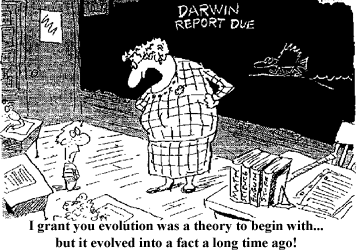
Survival of the fakest???


More than 500 scientists signed a statement proclaiming doubt about the accuracy of Darwin's theory of evolution. As signatories of "A Scientific Dissent from Darwinism," they stated, "We are skeptical of claims for the ability of random mutation and natural selection to account for the complexity of life. Careful examination of the evidence for Darwinian theory should be encouraged." Scientists holding doctoral degrees in biological sciences, physics, chemistry, mathematics, medicine, computer science and related disciplines are among the signers.

To see the document (pdf) click HERE.

Center for Science and Culture is interesting and related.

Related Tags: , , , , , ,

Monday, March 06, 2006

Breaking news: Rounds signs SD abortion ban

By CHET BROKAW
Associated Press Writer

Article Published: 03/6/06, 1:41 pm
PIERRE, S.D. (AP) – South Dakota Gov. Mike Rounds on Monday signed into law a bill banning nearly all abortions, setting up a court fight aimed at challenging the 1973 U.S. Supreme Court decision that legalized abortion.

The bill would make it a crime for doctors to perform an abortion unless it was necessary to save the woman’s life. It would make no exception in cases of rape or incest.

Planned Parenthood, which operates the state’s only abortion clinic in Sioux Falls, has pledged it will challenge the measure in court. About 800 abortions are done each year in South Dakota.

Rounds allowed a photograph to be taken when he signed the bill, but he said he would decline all media requests for interviews on Monday.

In a written statement, the governor said he expects the law will be tied up in court for years and will not take effect unless the U.S. Supreme Court upholds it.

“In the history of the world, the true test of a civilization is how well people treat the most vulnerable and most helpless in their society.

The sponsors and supporters of this bill believe that abortion is wrong because unborn children are the most vulnerable and most helpless persons in our society. I agree with them,” Rounds said in the statement.

The Legislature passed the bill after supporters said the recent appointment of conservative justices John Roberts and Samuel Alito have made the U.S. Supreme Court more likely to overturn its 1973 Roe v. Wade decision that legalized abortion. South Dakota lawmakers believe President Bush may have a chance to appoint a third justice in the years before the legal battle over the South Dakota law reaches the nation’s highest court.

The abortion ban would take effect July 1, but a federal judge is likely to suspend the abortion ban during the legal challenge. That means it would never take effect unless the state gets the case all the way to the U.S. Supreme Court and wins.

Rounds has said abortion opponents have already started offering money to help the state pay legal bills for the anticipated court challenge. Lawmakers also said an anonymous donor has pledged $1 million to defend the ban, and the Legislature set up a special account to accept donations for legal fees.

Under the law signed by Rounds, doctors could get up to five years in prison for performing an illegal abortion. The measure also contains language that the Legislature finds that scientific advances since Roe v. Wade was decided in 1973 have demonstrated that life begins at conception.

Rounds issued a technical veto of a similar bill passed two years ago because it would have wiped out all existing restrictions on abortion while the bill was tied up for years in a court challenge. The statement he issued Monday noted that this year’s bill was written to make sure existing restrictions will be enforced during the legal battle.

Saturday, March 04, 2006

Church Leaders Struggle with Strategy

(From FotF's Pastor's Weekly Briefing)

Nine out of every 10 senior pastors of Protestant churches consider themselves to be effective leaders. However, findings from new research by the Barna group show that few senior pastors believe they are effective in strategic leadership.

Strategic leadera are often mistakenly perceived to be managers because they tend to pay attention to detail, desire for efficiency and insist upon careful organization — all marks of a manager. The attributes often criticized about them include their critical manner (perfectionism), demanding nature (need for truth and integrity), and need to plan everything (analytical drive). They are also viewed to be impersonal.

The strategic leader's and the senior pastor's approaches to leadership are very different. Pastors are directing leaders who major in motivation empowerment, resource acquisition and vision casting. When a directing and strategic leader work together and share a vision, it makes for the best situation.

Signs that a church is lacking in strategic leadership are that it tends to remain numerically small (100 or fewer), are behind the curve in adopting new approaches to ministry and fail to embrace new technological tools for ministry. These churches also seem to be in a constant state of crisis due to failure to anticipate foreseeable problems.

Barna states, "The contribution of the strategic leader is profound. They bring balance, wisdom and well-conceived plans to the process. On their own, strategic leaders are ineffective. But when they are a valued member of a dynamic team, they enhance the leadership of their colleagues and the impact of their organization."

Related Tags: , , , , , , , , , , , , , ,

Friday, March 03, 2006

A 'freedom ride' to anti-gay colleges

(The following article taken from the liberal local newspaper, The Star Tribune. My comments are in RED.)

Four Minnesotans will be among a group of young people who will begin a bus journey to 19 Christian colleges that have anti-gay admission policies.

Pamela Miller, Star Tribune

When Jacob Reitan heard a young man talk about the pain and fear he felt as a gay student at Wheaton (Ill.) College, a school that opposes any expression of homosexuality, he got an idea.

Reitan, 24, of Eden Prairie, was inspired by such stories, as well as by an admiration for the civil rights activists of the 1960s, to organize a "freedom ride" that will travel by bus to 19 U.S. colleges with religion-based policies that exclude gays. The young activists, who are Christians, hope to talk with students and faculty members. This morning, Reitan and four others will fly to Washington, D.C., to join about 30 other "Soulforce Equality Riders" for training before they set out on their seven-week, cross-country crusade.

On Thursday night, hundreds gathered at Westminster Presbyterian Church in Minneapolis to honor the Minnesota participants -- Reitan; David Durand, 26, and Carolyn Westra, 25, both of Minneapolis; David Coleman, 23, of Delano -- and ride co-organizer Haven Herrin, 23, of Dallas.

I have a friend working toward ordination in the PCUSA, and it's these very things that concern both he and I about his future there. How is it that a church "honors" people who are advocating and intentionally promoting something clearly laid out as sin in the Bible? The answer is a low view of scripture. Who cares what it says, we want it to mean this...

Issues around homosexuality deeply divide U.S. Christians. Some believe the Bible compels them to oppose gay rights, while others say it calls them to advocate for them.

Two Minnesota colleges are among the schools the bus will visit -- North Central University in Minneapolis (April 17) and Bethel University in Arden Hills (April 18). Both denounce homosexuality in their statements of principle, posted on their websites.

Bethel is one of 10 schools that have invited the riders to talk with faculty members and students. North Central is among "a small few" where the riders may be arrested, Reitan said. A third group of colleges will allow them on campus but will not set up conversations.

In a prepared statement, Bethel Provost Jay Barnes said, "We are planning to host the riders for courteous and honest discussions. ... Our students are encouraged to form sound positions on cultural issues relevant to their Christian faith." North Central officials could not be reached for comment.

I was alerted quite some time ago that this group was coming (as the Seminary President). The school informed the whole of the student body over a month ago. I expect the "riders" will be well received and treated with respect inspite of their sin affirming campaign. I think Bethel's approach is the right way in dealing with this, we can't stick our heads in the sand and hope the issue goes away on it's own.

At Thursday's service, Coleman received a standing ovation after he spoke emotionally about being kicked out of North Central after revealing that he is gay.

"God loves you just the way you are," said Coleman, who was a senior when he was asked to leave the college last year. "Nothing can take us away from the love of God."

So let's see, you deliberately LIED to get into the school, and then are now complaining that when you revealed you had violated a fundamental segment of the school's principles they threw you out? Yeah, that sure makes sense. I agree that God still loves you inspite of your sin, but God is also very clear about His views on homosexuality.


Durand said the riders will speak "for those who can't speak for themselves, because they must stay closeted."

Said Westra: "These [anti-gay] folks won't come to us, so we have to go to them."

Errr....we're not anti-gay, we just don't want to be intentionally promoting a life style God has clearly condemned as sinful. Just as I don't promote pre-marital sex, pedophillia, murder, or suicide bombing as a way of life.

Thursday's service, which featured a civil rights theme, included a performance of "We Shall Overcome" by the Twin Cities Community Gospel Choir.

The Rev. Don Samuels, a Minneapolis City Council member, described his journey from anti-gay fundamentalist to believer that gay rights are civil rights, saying he was "embarrassed to think of some things I've said" in the past.

He described a seminary debate he won defending slavery using scriptural defenses as an illustration of how the Bible can be misused. "Holy men sometimes make flawed judgments with unholy consequences," he said.

I have no idea of who this "Rev." Don Samuels debated, but clearly his opponent must not have known much about the Bible and Biblical times if he couldn't oppose Samuels' support of slavery. So let's follow this arguement out. Since I once won a "debate" that I am my parent's favorite child, they can't love my brother, and furthermore, I am now justified in this belief. Make sense? Nope.


Reitan said the multiracial group feels a strong affinity with the civil rights movement, and has a common player in the Rev. Phil Lawson, a civil rights pioneer who serves on the board of Soulforce, a national Christian gay rights group.

Equating the gay rights movement with the civil rights movement is such an incredible injustice to the civil rights movement. One was God honoring, the other is SIN honoring, and you can't get farther apart than that. I have no idea where Rev. Lawson got his credentials to be a "Rev" but I'd give it a 95% chance that it was a liberal main-stream denomination school that long ago abandoned a high view of Scripture and thereby sapped the Bible of any real authority. We have two such institutions in the Twin Cities, Luther Seminary, and the bottom of the barrel United Seminary. I don't even think United requires you to profess Christ as Lord to be admitted. I'm not making that up.

Education, as much as protest, is the group's goal, Reitan said. "A lot of people don't know that I would not be allowed to attend Bethel," he said. "These policies are based on religion, but we don't believe that's what Christ came to do. He came to throw off old laws, to expand our understanding of what God meant. Perhaps talking to people, we can get them to see that they need not be so unbending."


Christ came to free us from the eternal ramifications of SIN. Christ KEPT the Law and Christ fulfilled the Law. He did destroy some of the laws created by man in His time, but you would be hard press to construct an argument that holds water with Reitan's views from the Bible. You are on one hand saying the Bible has no authority, or at best only authority that you CHOOSE to give it, but then on the other hand you want to use the Bible to build a defense, to justify, your promotion of SIN. Sorry, the Bible doesn't work that way. There is a thing called Hermeneutics that would be quite helpful if you would ever like to understand how to interpret the Bible.

Related Tags: , , , , , , , , , , , , , , , , , , , , , , , , , , , , , , , , , ,

Thursday, March 02, 2006

Do not call/Junk Mail...

I'm stealing the great info below from Justin Taylor on the Between Two Worlds blog. Share this with everyone you know!
__________________________________

I'm sure that most of you, like me, are absolutely sick and tired of receiving, sorting through, and tossing junk mail--not to mention screening telemarketers. The cumulative amount of time in dealing with this is quite significant. It's annoying, and it also could be disastrous (if you accidentally thought something was junk mail when in fact it was important correspondence from a company).

Here are some things to do:

Send two postcards to the addresses below. Include your name, address, zip, and phone number. Tell them to "Please activate the mail/telephone preference service." This will stop mail and calls from companies that you have ordered from.

DMA Mail Preference Service
PO Box 9008
Farmingdale, NY 11735-9008
http://www.dmaconsumers.org/cgi/offmailinglist

Telephone Preference Service
PO Box 1559
Carmel, NY 10512
http://www.dmaconsumers.org/cgi/offtelephone

You can also do this online (for $5) or print off their online form for free and mail it in. It takes longer if you submit it by snail mail. Don't give them your email address.

Use this free form to stop receiving emails from companies you've ordered with:
http://www.dmaconsumers.org/consumers/optoutform_emps.shtml

Also, when you sign up with a new service--for example, a new insurance company, a new bank--be sure to get their little brochure on privacy that they will send to you. They include a 1-800 number where you can opt-out of allowing them to share your information with other companies.

Call 1-888-382-1222, or go to www.donotcall.gov, to be placed on the National Do Not Call Registry. (Note: telemarketers can start using your cell phone now, so be sure to register that as well.) When I do receive calls, I've found that the key is not to even listen to them identify themselves. Usually I can tell if it's a telemarketer because our Caller ID either lists the caller as an unfamiliar name or lists it as anonymous. If you do pick up, there is usually a one second pause before they speak. And when they do speak, they usually ask to speak with "Mr. Taylor" or "Justin Taylor." Before saying anything else, I politely ask them to put me on their do-not-call list. They immediately, politely comply and hang up. (The reason is that it's illegal and they could be sued if they don't do this.)

Call 1-888-567-8688 or 1-888-5OPTOUT, which will stop junk mail sent by the following credit reporting companies: Trans Union, Equifax, Innovis, and Experian.

Stopping junk mail from companies you have not ordered from is not quite so easy. According to junkmailstopper.com, AOL is the world's worst offender. Call 1-800-827-6364 (6am-2am EST) and ask to be taken off of the list.

A few other major companies are:
  • ADVO: Call 1-860-285-6100 or send a postcard to "ADVO Consumer Assistance, POB 249, Windsor CT 06095-4176";
  • Val-Pak Coupons: fill out their online form but don't give them your email
  • Carol Wright: call 1-402-464-0044
  • American Family Sweepstakes: call 1-800-237-2400
  • Publisher's Clearinghouse Sweepstakes (call 1-800-645-9242 (8:30 am to 8:30 EST); send a postcard to 101 Channel Drive, Port Washington, NY 11050, or email pch@ant.net. "PCH will remove any number of names from a specific address, but you have to list each name exactly and insist nicely."

Finally, JunkMailStopper says: "Remember that any time you give out your name, for charity or warranty cards or whatever- you are almost always putting yourself on some list that will get sold over and over to companies that send junk mail. Always politely ask that your information stay private and not sold to junk mail lists."

Note that with all the options listed above, they (a) won't stop all junk mail, (b) won't take place immediately, and (c) will only last for about 5 years. So you can mark on your calendar now to look at this post again in 2011!

Thanks to the following websites for the helpful information:

www.junkmailstopper.com
http://www.obviously.com/junkmail/
http://www.cpsr.org/prevsite/cpsr/privacy/junkmail.html


Related Tags: , , , , , , , , , , ,

Wednesday, March 01, 2006

On Leadership and Calling: Ravi Z. Pt. 3


Go HERE for the first part of this series.
Go HERE for the second part of this series.


JC: In speaking about difficult times and perhaps adversarial areas, have there been any low points in your life that have influenced you in your ministry? A low point and perhaps a high point that you would like to share with us?

RZ: Low points were generally induced by fatigue. If you are not getting the sleep, your body is being subject to a lot of strain. You get down and you have those times. There are some times when there are low points where great disappointment comes to you, maybe in people, in relationships. I’ve seen some great disappointments, and one of the things that I’ve learned through all of that is you cannot build a steady faith on the basis of human observation. There will be people who let you down, and I’m sure we let other people down. They may not have the expectation that you have in leadership. I don’t mean in a moral sense; I mean in some reaction or whatever. So there have been some low points in the earlier days of ministry, some disappointments. But it helps to remember that you must keep your eyes focused on your calling, otherwise you will give up.

The high points are wonderful, but also must be tempered with a grain of salt. You cannot live just for the success or happy moments. To quote Nietzsche, this requires “a long obedience in the same direction.” The high points and the low points are markers along the way, but you have to keep the plain road ahead of you and not be guided by the extremes. They are the punctuation marks in life. For instance, a high point may be a wedding day, but the days that follow is where you really demonstrate what it means to be married. The emotions are not as mercurial as the high point in that sense, but your heart does that which is right.

JC: We are sitting in your office, and I see a lot of books on the wall. Is there any book outside of the Bible that has influenced you and your thinking?

RZ: There are several of them, but it is authors who have influenced me: Malcolm Muggeridge, G.K. Chesterton, F.W. Boreham, C.S. Lewis. Contrary to what a lot of people think, although I’ve read and loved Francis Schaeffer, my calling and mind had already been shaped by then. I would probably say the most powerful book I read in the eighties that changed my thinking an awful lot is G.K. Chesterton’s Orthodoxy. I think it is one of the greatest books ever written.

JC: What about accountability structures? Are there any specific accountability structures you have in your life right now?

RZ: You know, John, when I looked at the questions, I thought, this is particularly a good one, but it’s one of the toughest ones to answer, and I’ll tell you why. My answer may be very different to what others may give you. As I see it, accountability comes at different tiers.
First, I believe I have a theological accountability, a doctrinal accountability. That’s why I have always retained my ordination and my license with the Christian and Missionary Alliance. I have a doctrinal accountability to a denomination. We are not flying by the seat of our pants and manufacturing our own little theology as we go. I believe it is important to have that.

Then there is leadership accountability we put into our planning at the beginning of each year. My executive committee has time alone with me. We talk about things like my travel, my daily issues, what I’m wrestling with. There is a leadership accountability to a group of men and women who in turn are accountable to the Evangelical Council of Financial Accountability.

I really believe that I am also accountable to my wife and children. How do I measure that? I measure that by my availability to them and my willingness to listen to what it is they want to talk about. How do I do this? One of the things I’ve done is I do not take my engagements. My wife does. All of my itinerary is planned by her, so I go with her blessing and not simply justifying everywhere I want to go. This is critical. My life is on the road. I’m away from home fifty percent of the time. How do I remain accountable in that? I don’t travel alone. In fact, the only time I am alone is when I’m writing, which happens maybe twice a year for a week. I stay in areas where I am known by the hotel personnel, so I am accountable in that sense. They know I’m a minister; they know what I do; they know my books; they know I’m preaching; they’ve heard my tapes, etc. I think that is important. I’m not alone.

Out of the fifty-two weeks of the year, there are maybe two weeks when I’m by myself writing. But here is the key: Deviant ways begin in the days of success when you do not have financial accountability to anybody. I think it is important to know that. When I’ve watched the lives of the big men who fell, there was a lot of money involved. The money became the means of procuring what it is that felled them. Yes, power, but money is a big thing.

I believe that if you are going to remain honorable as a minister of the Gospel, you should always be accountable with your money to your spouse. To me, that is critical. You show me a man who has his own bank account and his wife knows nothing about it, and I’ll show you a man who will probably get into trouble if he is not careful. My wife needs to know where my money goes if I’m spending it. She needs to know what checks I issue; she needs to know what I withdraw, and to me this is a very real thing that we talk about.

I talk about this to my colleagues. So accountability to me is when proclivities have resources, then possibilities become actualities. If you cut off the resources, you are in one way trying to stop the cash flow. I’ve watched fallen lives and I said money is key here. To me, accountability starts off with moral and doctrinal with your denomination. They are able to deal with me if I am not towing the line. Then, accountability to my executive committee, where they talk to me and ask me the questions they want. There is the accountability to my wife and children. An accountability on the road to where I don’t travel alone. I have a traveling associate who is with me all the time. He knows where I am twenty-fours a day, and I don’t go out at night on the road if I am not speaking. When I’m in my room at night, I don’t watch much television. If I ever do, it is either news or sports. I could go a week in a hotel room and never turn the television on.

These are measures one has to take because no matter how many exterior structures there are, if you are not honest inside, you will find ways to be dishonest. The structures in that sense are restrictions; they are not absolutes. To me the key is, Who knows where your checkbook is, who knows where your money goes? If your heart is in the right place, your fiscal accountability should be under some one else’s scrutiny, and I keep that under my wife’s scrutiny.

JC: That’s a wonderful answer. Here is the last question: Is there anything we have not covered that you think may be helpful to me and my colleagues? We are talking about leadership, and you probably have a lot of different ideas of how we could develop this, but is there anything you feel needs to be said about leadership in general?

RZ: I think there are two or three things that I feel are so important if the church is going to be the church among the leaders. Number one is humility. We really need to have a humble heart. God says in Deuteronomy, chapter eight, I wanted you to see what was in your own heart. I mean, He could have taken them six weeks across and brought them into the Promised Land, but He had them for more than forty years so they could see what was in their own heart. A true appraisal of my own heart and every man and woman’s heart is that we need to be humble before God.

The second thing is that not only should you be humble, you must be very disciplined. A leader has to be very disciplined. The ministry can induce laziness, especially in our kind of work where you repeat. We can repeat an awful lot. That makes for laziness when we think, I got my sermon case and I got my hundred sermons in the bag, I don’t need to be studying. That’s not good.

Your time with the Lord is so critical. Every day, the nourishment of the soul needs to take place, probing new subjects, studying new material, reading new books, not lazing in the morning hours, getting yourself out of bed. If I could see humility and discipline as the twin realities brought into young ministers’ lives, the future would be very bright. If we lose humility and discipline, we will end up being professionals at what we are doing where appearance will become more important than substance. So, as you are looking at leadership, humility and discipline are two very critical roles for young men and women as they labor to go into the ministry.

We have a great crop of young people coming up, but the problem is we have great temptations that stalk them, and so many of them go wrong so soon that we end up in salvage operations after that. If someone wants to go into ministry, my suggestion is: Find someone who can keep an eye on you early so that you don’t develop bad habits that are hard to change once you get into ministry. Bad habits are formed early. Once you develop bad habits, they stalk you even after you’ve entered ministry. How you deal with members of the opposite sex, how you deal with fatigue, the challenges to your capacity, and the parameters of your own capabilities. Find the right habits to respond, the habits of the heart, and they will stay the course with you in the long run.

We should not underestimate the role of leadership. I would have to say, I did. If you do not lead, somebody else will. If you are called to lead and you don’t lead, somebody else will. Biblical leadership takes its role seriously. With a servant’s heart, people will follow a good leader, who is setting the example at the same time. It should never be underestimated.

Related Tags: , , , , , , , , , , , , , , ,

Tuesday, February 28, 2006

On Leadership and Calling: Ravi Z Pt. 2

Click HERE for the first part of this interview.

JC: How important do you feel character is in the realm of leadership?

RZ: Definitive. I think if character is not there, you are not only destroying the role that you are called to, but the message that you are carrying. You are in effect becoming a counterpoint to what it is you are propagating. When I think of character, I think of not only behavior, I also think of motive. Motive is key, that which drives a person to do this.

You see, the pulpit can become quite the show window for a person and it can become a big ego thing. You see it happening again and again, much more than you would want to or even thought it would happen. When I think of character, I just don’t think of obedience or of simply being aligned with the claims of God upon your life. I think of it as the very motive: What it is that drives you to serve and do what it is that you are doing?

I really think that today, as Christian apologists, that the biggest challenge to the faith is not an intellectual question. In fact, I have not heard an intellectual question to the faith that has disturbed me. I am more convinced than ever of the message of the Gospel. But the biggest challenge to the Christian faith is this: If the message that we have lays claim to a supernatural regeneration, then why is it that we do not see that regeneration more often? No other religion claims a supernatural regeneration. They may claim ethics and morality. Hinduism does. But we are the only ones who claim a new birth. Born of the Holy Spirit, our hungers have changed, our disciplines have changed, our behavior has changed. If it is a supernaturally engendered thing, why do we not see it more often? And if that is true of the common person in conversion, how much more true it must be of ones in leadership. So I believe character is essential, and without that, you cannot serve.

JC: Where does competence play out in this area of leadership? You’ve talked about the calling, you’ve talked about the character formation that needs to be in place. What about the competence level of leadership?

RZ: This obviously is very important. I think Billy Graham made a very simple statement years ago when he said it was a great day in his life when he learned that God can use good organization. We sometimes are haphazard. Sometimes we are ill-equipped. Sometimes we are ragged in our planning and doing. Competence is very important, especially in the gifted situation. You have the calling to be an expositor of the Gospel. You have that gift within you; it is there. The competence is shown by somebody who works at what it is that he is gifted and called to do. If a leader is not competent, many things will fall by the wayside. In the organization that he works with, there will be ripple effects of failure. The disciplines that are needed for sermon preparation and delivery will be taken for granted.
I think this whole idea of organization building—of the process that has to be taken on when you are moving from point A to point B—the vision and the passion in you wants to take you in that direction. However, the passion and the end will not automatically come together because it takes competence to get you there. Competence is a big word. It is important. I almost want to nuance it with the idea of giftedness because sometimes you can teach a lot of skills on exposition but a person may not have the competence or the giftedness to do it. Therefore, it is very important to have that.

JC: We added a word: community. We discussed the importance of leadership in the community that a person is engaged in and the type of impact that is needed in order to make change possible. Do you see community as being an important part of leadership?

RZ: Very important. I am more and more convinced, as the seventies and eighties have brought to our attention, you cannot have lone horses out there. There are dangers to it. That’s one of the reasons why our organization is a team. It would have been very comfortable in a self-serving way to be the lone member of this organization and carry on with all of the privacy and all of the privilege of funding, etc. and keep going that way, but I never wanted it that way. I keep telling members who join the team: “You need to be part of a community. There is a fraternity that we all must have. Fire begets fire. Iron sharpens iron.” And not only that, if the church is a community, then how can you in your own life not be part of one and expect to build community while you yourself are in isolation? Many entailments come from the concept of community.

In this postmodern era, one of the few redeeming factors is that there is still hunger for community. It is important that we understand how God has so fashioned us. The starting point of good apologetics is Trinitarian, and God Himself is a being in relationship. He has fine tuned us that way. So community is an essential part of what I do as a leader and what I do in my leadership.

JC: That is so very true. You spoke about your calling, and this is a personal question: Was there anything that came as a confirmation of your calling to do this type of work more than anything else?

RZ: Yes, there were several things. Most important are the people God brings into your life. John Stott played that early role when I was looking for a seminary and he directed my paths to Trinity. It became the school where I needed to be and with members of the faculty: Walt Kaiser, J.I. Packer, John R.W. Stott, John Montgomery, Norm Geisler, John Gerstner, Carl Henry, and Kenneth Kantzer. There were some fine men and women teaching in that seminary at that time. That was the first thing; God took me there.

But before RZIM was formed, I was a professor at Nyack, the Alliance seminary, and I had just spoken for Billy Graham in Amsterdam in 1983. I was flying back from there and I thought to myself, Apologetics… How desperately it is needed. All of my evangelism, as I heard it then, was geared to the unhappy pagan, as it were. And I thought, What about the happy pagan? What about the person who has questions and feels no need? What about that type of person? They are more lost in a sense, and desperately in need of finding the Savior.

I wanted to start an organization and I said to Margie, I wish we had $50,000 to get a ministry like this going. She sat back in her seat and chuckled and said, “That’s a lot of money.” I was a seminary professor. I said, “If God were to bring that in, I would build an organization to reach the thinker and train men and women to do Christian apologetics all over the globe and to do it well.” That was in August. I came back and resigned. I gave one year’s notice, really believing that the Lord was leading us. She was uneasy with this. I was uneasy too, and we made one agreement: We would not tell anybody what we were thinking.

In November of that year, two months after that, I was speaking in Ohio to three hundred laymen, and after my last message I made this comment: “As you are driving back to the airport, would one of you in each car pray for God’s leading in my life? I am seeking Him and his wisdom in a certain matter. I cannot tell you what it is, just pray for us.” They did not even know that I had resigned from the seminary, effective one year after that. I went back to my room and picked up our bags. Margie and I were walking out, and there was a man standing there. He said, “Can I talk to you for a minute?” I said, “Yes.” He said, “I don’t know what it is you are seeking God for, but I went back to my room and got on my knees and said, ‘God, what is it that that young couple is seeking wisdom for? Is there a role you want me to play?’” The man said, “I have no idea what it is you are seeking wisdom for, but I just got off my knees with God impressing me to give you a check for $50,000.”

I thought to myself, This is unbelievable. I mean, I have never received anything like that in my life. I looked at him and said, “Sir, I don’t even know you.” He said, “I’m going to trust you.” I said, “You know, that is a lot of money to take from a stranger. I cannot do it. But if you tell me where you live, I will fly in sometime in the next two months to see you. We can talk, and then if it is still on your heart, we can move forward with that.” He said, “You’re a busy man. I have a plane. Tell me where you live; I’ll fly in to see you.” And he flew to New York where we lived, to White Plains. My wife and I shared with him the vision to reach the thinker and he had tears in his eyes. He said, “I’m not an educated man, but I know how to make money and God has blessed me. You stay faithful and you stay honorable. I’ll take care of you. I’ll support your ministry because God has his hand on your life and you are reaching a segment of society that needs to be reached.” That was 1983. In January, we called together fifty friends, and this ministry was born in August of 1984.

That was just one link, but there were a series of links from John Stott directing me to the seminary to the man, Mr. D.D. Davis. He passed away very suddenly two years ago. Also, the wife God gave me, who affirmed and reassured me. There are so many things to affirm that this was of God.

JC: That is quite a remarkable story. Here is an interesting question: Is there a relationship between your conversion and your call that is more than just incidental?

RZ: I think to me there is a very clear relationship. Sometimes it may not always be that evident. God raised Moses in a palace in order to use him in a desert. He raised Joseph in a desert in order to use him in a palace. God always works in some marvelous and mysterious ways. Although that theme in many ways is a bit of a cliché, God did prepare Moses to stand before kings and leaders. I think in my conversion, there are two or three things.

First, in my ancestry. My ancestors going back four or five generations were of the highest caste of the Hindu priesthood. They were priests in South India, the top rung of priests. They were officiants at ceremonies; they were Nambudiris. The Nambudiris are on the top rung of Hindu priesthood. And yet, they came to know Christ. I now look at my family tree and think it is remarkable. My great-grandfather and my grandfather were linguists. They translated the first Malayalam-English dictionary, which is one of the most difficult languages in the world. It’s the Webster’s of the Malayalam language. It’s spelled front and back the same way. It’s a very tough language. They were into languages. My great grandfather translated the works of Shakespeare and Arabian Nights; he was a linguist. When I think of my life as being so involved in words, I think of God putting in that DNA right from the beginning.

The second thing is that my conversion was on a bed of suicide. I was empty, purposeless. Those are the issues I address today and people sit up and listen. When you talk about life’s meaning, everyone wants to hear your answer. People are looking for that. I was raised in the Anglican Church, and I never knew Christ. But now as I look back, the Anglican prayer book is a masterpiece—the hymns, the liturgy. I now think of worship as the clue to the meaning of life. So all of this, being raised in India, living in the West, connecting now between East and West, there is no doubt in my mind that my calling, my upbringing and conversion, there is a very real strand tying it all together.

JC: You have certainly given us definition of your calling. Has there been any time over the past in which you felt your calling has changed to some degree?

RZ: Not in the recent past. But twenty years ago when this ministry as an organization was formed, I moved from being an itinerant evangelist to an itinerant evangelist-apologist. Apologetics became the seasoning in the main course that I offered, which is the Gospel of Jesus Christ.

Apologetics does not dominate our message; it undergirds our message. Argument doesn’t save people, but it certainly clears the obstacles so they can take a direct look at the Cross. The change came when I recognized that I needed to be in hostile and adversarial areas because those are where the people are that need to be rescued. That was a big change for me, moving from the comfort zone of church evangelism, where I cut my teeth. However, I’m still licensed and ordained by the Christian and Missionary Alliance. I’ve covered the globe for them. I’ve covered the country for them—little churches, country churches, big churches. I miss some of that; it was wonderful.

But God moved me away from my comfort zone. That is why we turn down ninety-nine percent of our engagements. I take very few within the Christian world. As much as I want to be there, I take a few for my need so I can be replenished and blessed, but my primary ministry is in adversarial settings.

Related Tags: , , , , , , , , , , , , , , , , , ,

Monday, February 27, 2006

On Leadership and Calling: An Interview with Ravi Zacharias Pt. 1

Ravi Zacharias and Major John Carter
2005 - Fall

Ravi Zacharias was interviewed in April 2005 by Major John Carter of The Salvation Army for a leadership class at Gordon-Conwell Theological Seminary (Charlotte, NC branch).

Major John Carter: In our leadership class, Dr. Zacharias, we discussed metaphors or images which guide leaders. Do you have a metaphor or image which has guided you in your life?

Ravi Zacharias: I think the best description I would give is that of a “privileged servant.” That would be the best description. There are different types, of course, but the Son of Man came to seek and to serve. I remember a number of years ago being a part of a conference in Wales where the theme on Christ was “The Servant King.” If the King Himself came as a servant and to serve, then that should be the model we have for ourselves. So I see it as a privileged servant. Coming from the East, where we had trusted, household help, trusted servants in the home, my father would trust them with the entire household, the children, etc., doing all types of things. This is our role, being a real servant of the King.

JC: That’s a wonderful metaphor and image of what we should think of, when thinking of our role, in Christianity. What biblical leaders are most important to you, perhaps in defining your own leadership?

RZ: There are several of them actually. In the earliest days, when I first looked at my calling, Jeremiah was the one, as the weeping prophet. The one who had such a tender heart towards so many things and yet had to be taken into such tough situations. One of the things God has fashioned me with is a tender heart. I have never been able to deny this or speak in laudable terms or in less than laudable terms than just to tell you the way I am or who I am. When I see a need, my heart is touched. I think that comes through my mother, who was a very tenderhearted woman. Looking at Jeremiah and the demands God placed on him, with all of the questions that he had, he was always raising questions before God, Why, why, why? And yet he had such a tender heart. Being told at one point that he was not going to be able to marry, and here was a man that needed that type of support, but didn’t have it.

Then, as time went on, because of the reluctance in my own heart, I would say Moses became a model for me: “Here I am, send Aaron.” I always felt unprepared and ill-prepared for this. I’m not comfortable in front of people. I do not like the attention that it brings. I love my anonymity. I’m not necessarily comfortable as a speaker; I’m more comfortable writing. I do not like leaving home and yet half of my life is spent on the road. I would rather step back and let somebody else do it in the forefront, so Moses became that model leader that I looked at. I could see why Moses questioned whether or not he should go and whether or not he felt prepared.

But in the last few years, I think the one who has best represented my calling is the apostle Paul. Abnormally born as it were, wrenched from the womb (in terms of calling), the convergence of various cultures into his life—the Greek, the Hebrew, the Roman, and now speaking to the Christian. The one who was a traveling missionary; the one who reasoned with the Epicureans and the Athenians. His apologetic especially given to Felix, is, I think, absolutely marvelous. He reasoned with Felix of righteousness and self-control and the things to come—the judgment and points of relevance, points of reference, points of disturbance—which is what apologetics is all about. So I would say in these last few years of my ministry, Paul has become that person.

JC: Are there any leaders outside of the Bible or outside the church that may have influenced you in a specific way?

RZ: Yes. They do in terms of their writing. I love reading some of the great authors of our time. I think John Piper is clearly one of my favorites. He plumbs the depths of the Scriptures and keeps God always as God before us and we as his creation. English writers have also helped me greatly. In terms of leadership, I have learned a lot from the life of a man like Joseph Stowell, [former] president of Moody. I’m just a few months younger than he is, but Joseph has modeled a lot for me. My pastors I worked under while I was a young man. My professors were very influential in my life in the early days—people like Norm Geisler, his impact on me. And prior to that in my undergraduate studies, from a methodology point of view, there were people like John Montgomery in the early days.

In terms of the leadership model, I also learned by observing fine pastoral men. Going back to India, just after my conversion, there was a man named Sam Kamaleson who became the vice president of World Vision. He led their pastoral conferences. There was John Tiebe, who was a Canadian and was a Youth for Christ Director in Delhi under whose watch I really came to know Christ. There was Sam Wolgemuth, who was also the great Youth for Christ International Director. In reference to these men, there’s something you borrow, not always specific, but an impression that is left in your mind. That impression begins to grow, nurtured by your reading and your studies. Observing the kind of men I worked under, they left me with this impression and a desire to be like them.

JC: In our leadership class, we discussed the paradigm from Jeremiah in the third chapter that related to calling, character, competence. We then we added a fourth word that could also be included, which was community. Dr. Zacharias, do you feel called to do this type of work?

RZ: Absolutely. And I don’t use that word lightly. Yesterday, as I was driving my wife to the airport (she was going to see her father who is not well), I said to her, “You know, if it weren’t for the call of God, this is not what I would do.” It demands a type of mental mindset, especially the travel side of it. It takes its toll physically and emotionally. I’ve never wanted to be away from my wife and kids for any period of time, and yet that’s what I have to do in my itinerant world. I think to know that you are called is a seal within your heart. I might also add—this is one thing that is not stressed for many who go into the ministry at this time. Today it is almost a manufactured profession. John Stott’s comment years ago was very appropriate when he said that the pastor’s study is replaced by the terminology “pastor’s office.” He said the study is where you learned and understood and heard from God and then went and spoke to the people. The office is where you manage a group of people. And without pushing it too far, the point is still well taken.

A calling is a beckoning. It is something like Samuel Wesley dying and telling his son: it’s that inner witness. There is something in your heart that God seals, and when I look at the way it has happened, the steps one after another, I could never have engineered any thing like this. I wouldn’t have wanted to or had the capacity to. It’s the calling of God that prepares your heart and prepares the place for your heart. No doubt, I am a hundred percent sure in my heart that God’s calling is on my life to do this work of a Christian apologist.

Related Tags: , , , , , , , , , , , , , , , , , ,

Saturday, February 25, 2006

Toro's former CEO to speak on servant leadership...

Toro’s Ken Melrose to discuss ‘leader as servant’ at March 16 breakfast

Ken Melrose, executive chairman of the board of Toro Co., will give the next breakfast talk in a series co-sponsored by St. Olaf Catholic Church and the John A. Ryan Institute for Catholic Social Thought at the University of St. Thomas.

The ecumenical Faith and Work Breakfast will be held from 7 to 9 a.m. Thursday, March 16, in Fleming Hall of St. Olaf Catholic Church, 215 S. Eighth St.

Melrose is retired as Toro’s CEO and is the author of Making the Grass Greener on Your Side: A CEO’s Journey to Leading by Serving. He will speak on “The Leader as Servant: A Path to Spiritual, Personal and Business Growth.”

While serving and leading appear to be opposites in the world of work, Melrose will discuss how servant leadership is key to helping employees grow and contribute in ways that support the company and community. He also will explain how the leader-as-servant concept works in the competitive world of business, just as it does in the areas of health care, education and nonprofits.

Now in their 12th year, the Faith and Work Breakfasts deal with the personal challenges of faith-and-work integration and are designed for professionals from all faiths. The program has received recognition in Excellent Catholic Parishes: The Guide to Best Places and Practices by Paul Wilkes.

The cost of each Faith and Work Breakfast is $18, which includes a continental breakfast. Pre-registration is encouraged. To make a reservation or for more information, call St. Olaf Catholic Church, (612) 767-6204, or e-mail jmiltenberger@saintolaf.org. Information also is available on the Web at http://www.saintolaf.org/events.htm.

Related Tags: , , , , , , ,